



Selling software through AWS should unlock scale, not create endless admin work. An AWS Partner Integrator is an AWS-vetted and validated platform that automates the complex backend operations of AWS Marketplace and AWS Partner Central. By connecting your CRM directly to AWS through official, secure APIs, an integrator lets your team create private offers, track usage, and sync ACE co-sell deals without ever logging into an AWS portal.
This guide shows you how a partner integrator helps you sell and co-sell scalably through AWS.
TL;DR
- A partner integrator smoothens your AWS Marketplace and co-sell operations: listings, private offers, co-sell, metering, and deal sync between your CRM (customer relationship management system) and AWS
- You own the pricing, sales, and the customer relationship. The integrator keeps the AWS connections working
- An integrator pays off once portal work starts slowing deals. With one listing and spare engineering time, AWS's own tools may be enough
What is an AWS partner integrator?
An AWS partner integrator provides and manages the infrastructure you need to list, transact, and scale on AWS marketplace. It provides tooling as well as human expertise to your team for every stage of your marketplace journey.
AWS partner integrators like Clazar connect your CRM and business systems to AWS Marketplace and AWS Partner Central. Your sales and finance teams then work from the CRM instead of AWS portals. They also automate and manage private offer workflows, usage metering, billing, and co-sell opportunity sync, so your team can focus on growth.
You keep the decisions and relationships, and the integrator keeps the AWS operations running.
Partner integrator vs. systems integrator, MSP, and reseller
A partner integrator works on how you sell through AWS. The other three partner types work on your infrastructure or your customers.
How does a partner integrator help ISVs?
A partner integrator takes over the technical and repetitive work involved in selling through AWS. While the scope varies by provider, the areas below are usually what most integrators cater to.
Marketplace operations
An integrator like Clazar eliminates the heavy lift from cloud marketplace operations. This covers marketplace listing setup and updates, the buyer registration page, private offers, renewals, CPPO, and usage metering. Without an integrator, your teams will do most of it by hand in the AWS Marketplace Management Portal (AMMP). With one, your team can work from their usual CRM instead of needing to manage multiple screens.
The integrator maps your AWS data into Salesforce or HubSpot and keeps it current. Reps see co-sell status and offer status without logging into AWS.
Marketplace events can also trigger CRM actions. For example, when a buyer accepts a private offer, the integration can update the deal in Salesforce and alert the account owner in Slack. When a contract is 30 days from expiry with no renewal started, it can flag that too.
Co-sell and ACE opportunity sync
Co-selling with AWS sellers is the natural way to scale your business on the marketplace. You share those deals through ACE (APN Customer Engagements), part of the APN (AWS Partner Network). An integrator syncs co-sell opportunities both ways between your CRM and Partner Central, so nothing gets lost between portals, and your teams work with updated information at all times.
And that’s not all. Capabilities such as buyer propensity scoring and draft opportunity evaluation help to improve the quality of your co-sell submissions, increasing your conversions over time.
Pro Tip: Standard CRM integrations often miss custom fields (like regional sub-territories or specialized product add-ons). This leads to deal updates being flagged for manual review by AWS reps, lengthening approval cycles. Clazar supports custom field mapping between Salesforce/HubSpot and ACE, ensuring your team's specific deal criteria pass directly into AWS workflows without manual re-entry.
Revenue tracking and reporting
Integrators pull billings, disbursements, and listing fees from AWS and tie them to CRM records, so finance teams don’t spend time reconciling spreadsheets. This also helps Alliance teams accurately show how the marketplace as a channel has contributed to the overall business.
Pro Tip: With Clazar’s enhanced analytics, revenue recognition and reporting is even easier to do. What’s more, with the MCP Server and Clazar AI at your disposal, getting the right information is as simple as asking a question.
Keeping up with AWS changes
Each time AWS updates Partner Central, its APIs, or its requirements, teams that are live on the marketplace have to adjust and rebuild their systems to comply. An integrator absorbs changes like these, and handholds your team through them too, ensuring your work can continue uninterrupted.
Providing expert guidance and support
Besides software, a partner integrator also gives you easy access to experts who know how marketplaces and cloud partnerships work. Whether you’re a startup just beginning with private offers or a large enterprise with millions of dollars in transactions, having someone like that on your side cuts your operational effort. For example, with Clazar, ISVs have access to outcome managers and technical support for every step in their journey.
Multi-cloud and multi-entity selling
For companies taking a multi-cloud approach to cloud marketplaces, integrators can significantly reduce complexity. Integrators like Clazar help you run listings and offers across AWS, Microsoft, and Google Cloud marketplaces from one place.
They are also useful if you wish to expand geographies. A company might sell to local buyers through its Indian entity, then add its US entity for global deals. Each entity needs its own seller account and its own bank and tax setup. That's a lot to run by hand; a cloud marketplace management platform can smoothen things.
AWS funding requests
Some AWS funding programs run only through an AWS partner integrator. To qualify for such funding, your fund request must go through an integrator. Program names, amounts, and rules are set by AWS and change often, so check current terms before you plan around them.
Your relationships with AWS sellers stay yours. An integrator removes portal work. It doesn't sit between you and your AWS account manager.
Should every ISV work with a partner integrator for cloud GTM?
You can list your product or service on AWS Marketplace without going through a partner integrator. Especially if you are just looking at a single listing with only a few private offers each quarter, and no co-sell motion, you may prefer to manage it manually.
However, if you want to scale your marketplace revenue and build a serious co-sell rhythm, or if you are live on more than one cloud marketplace, working with a partner integrator like Clazar can cut the operational effort and technical bandwidth required to build and maintain systems.
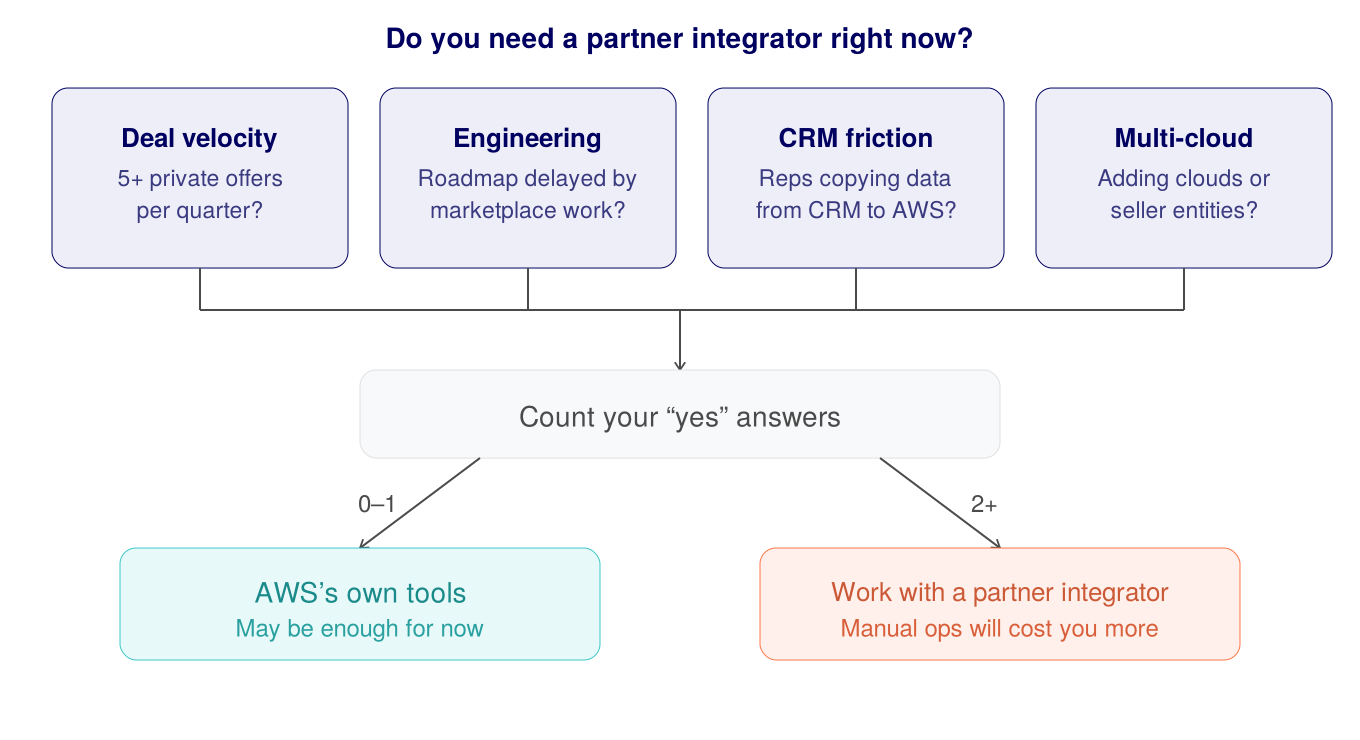
Decision framework: Do you need a partner integrator right now?
Ask your team these four diagnostic questions:
- Deal velocity: Are you running (or planning to run) more than 5 private offers per quarter?
- Engineering priority: Are core product roadmap items getting delayed to handle marketplace metering, notification webhooks, or AWS API updates?
- CRM friction: Are sales reps spending hours copying deal data back and forth between Salesforce/HubSpot and AWS Partner Central?
- Multi-cloud/multi-entity: Are you expanding to other cloud marketplaces, or adding regional seller entities in the next 12 months?
Verdict: If you answered "Yes" to two or more of these questions, you will benefit from working with a partner integrator. At this stage, managing marketplace operations manually or attempting an in-house build will cost you significantly more in lost deal momentum and engineering bandwidth.
The hidden cost of building in-house vs. using a partner integrator
Building a custom AWS Marketplace integration isn't a one-time project; it's a permanent software maintenance commitment. Consider these aspects when making the build vs. buy decision.
Also Read: How to scale on AWS Marketplace with a lean team
How does Clazar support you as an AWS partner integrator?
Clazar is an AWS partner integrator that helps ISVs automate and streamline marketplace operations, including private offers, usage metering, and revenue analytics, as well as co-sell workflows.
Here's how that looks day to day:
- Clazar handles buyer registration, technical integration, pricing setup, and testing. ISVs can get listed on AWS in as few as 3 days, without engineering work
- If you're moving from another integrator or an in-house build, 1-Click Port brings over listings, offers, contracts, and metering history
- Thanks to bi-directional CRM integrations, reps create and send private offers directly from Salesforce or HubSpot, with product details, pricing, etc. pulled from the CRM
- Engagement and propensity scores in Clazar help teams prioritize the most relevant co-sell opportunities to refer to AWS sellers
- AWS's Opportunity Quality Score and recommendations write back to your CRM on each co-sell deal, helping you consistently improve the quality of your submissions
- Detailed analytics help teams track revenue, marketplace performance, and co-sell impact in one place
- Clazar also helps ISVs identify and unlock the AWS partner funding they qualify for, and coordinates and tracks the applications
- Each account gets an outcome manager and a technical consultant, who support your cloud GTM efforts
"Clazar has been a huge unlock for us and enabled my team to route more deals through the marketplace. It sits right within our SFDC, and with all the automation in-built, it just works."
Andre King - Director of Sales, Rootly
Apart from AWS, Clazar also supports Microsoft Marketplace and Google Cloud Marketplace, so it is a good choice for companies adopting a multi-cloud strategy.
See how Clazar works as your AWS partner integrator, from first listing to co-sell sync. Book a demo today.
Frequently asked questions
What is a partner integrator on AWS?
A partner integrator is an AWS Partner that helps to connect an ISV's systems to AWS Marketplace and Partner Central. They automate listings, private offers, metering, and co-sell workflows and help teams make the most of their cloud partnerships.
How does a partner integrator automate AWS ACE co-sell?
Instead of manually logging into AWS Partner Central to submit and track deals, a partner integrator creates a bi-directional sync between your CRM (Salesforce or HubSpot) and ACE. Integrators like Clazar also automatically pull Opportunity Quality Scores and recommendations into your CRM while scoring buyer propensity, so your revenue team prioritizes high-converting co-sell deals.
Do I need to be an AWS Partner to work with a partner integrator?
You need your own AWS Marketplace seller account to sell on the marketplace. For co-sell, you also need an AWS Partner Central account linked to it. The integrator works inside those accounts, it doesn't replace them.
When should an ISV choose to work with a partner integrator over building an in-house AWS integration?
If you only have one static listing and conduct fewer than 5 private offers per year without co-selling, an in-house build or AWS's default tools may suffice. However, as soon as manual offer creation slows deal velocity, your engineering team is burdened with API maintenance, or you expand to multi-cloud (AWS, Azure, GCP), working with a partner integrator becomes significantly cheaper than maintaining custom infrastructure.
Can an AWS partner integrator handle multi-cloud marketplace selling?
Yes. Platforms like Clazar act as a unified Cloud GTM hub. This allows ISVs to manage private offers, metering, listings, and revenue reporting across multiple marketplaces such as AWS Marketplace, Microsoft, Snowflake, and Google Cloud Marketplace from a single dashboard.