.svg)
.svg)
.svg)

Most enterprise deals on AWS Marketplace close through private offers rather than the public listing price. But the AWS Marketplace private offer types available to you (standard, express, and channel partner) each carry different product requirements, term flexibility, and workflows. Picking the wrong one means rebuilding the offer later.
TL;DR
AWS Marketplace has two kinds of offers: public and private. A public offer is the listed price anyone can buy. A private offer is a negotiated deal visible only to the buyer accounts you name.
What people call "private offer types" are variants inside that second category. A standard private offer gives you full control over every term and works with all five AWS Marketplace product types. An express private offer is generated by AWS from rate cards you configure in advance; it covers SaaS Contract products only but closes in minutes. A channel partner private offer (CPPO) is the route when a reseller is transacting the deal. Which type you use depends on your product type, your deal size, and whether a partner is involved.
What is a private offer on AWS Marketplace?
A private offer is a custom deal between you and a named buyer, replacing your public listing price. You set the price, the contract length, the payment schedule, and the end user license agreement (EULA). Only the AWS accounts you target can see it.
Once the buyer accepts, the offer becomes an agreement. That agreement is the record of the transaction, and it is what your billing and disbursement reporting is built on.
A private offer is not a discount code layered onto a listing. It is a separate commercial object with its own terms, which is why the type you create constrains what you can do later.
The 3 ways to create a private offer in AWS Marketplace
AWS Marketplace has two offer types: public offers and private offers. For private offers, different creation paths and feature sets are possible, depending on who is selling and what is being sold.
Standard private offer
A standard private offer is the default path. You build it yourself in the AWS Marketplace Management Portal (AMMP), or through a connected platform like Clazar, and set every term.
Use a standard private offer when the deal has anything unusual in it, such as:
- Custom dimensions
- A negotiated EULA
- A multi-year term
- A staggered payment schedule
Standard private offers support the widest range of products and terms. However, since every offer is assembled individually, at volume it can become an unmanageable process for sellers.
Express private offer
An express private offer is generated by AWS from rate cards you configure in advance, rather than assembled by you deal by deal. It covers SaaS Contract and SaaS Contract with Consumption Pricing products only. Every other product type stays on the standard path.
How express private offers work on AWS Marketplace
AWS has a three-step workflow for express private offers.
- You set up rate cards. You define your base pricing and dimension descriptions, and set contract duration limits, EULA requirements, and how long an offer stays open. Then you choose your discounting approach: dimension-based, total contract value (TCV) based, buyer-profile based, or an approved combination
- The buyer requests an offer. They select ‘Get Express Private Offer’ on your listing. An AI agent qualifies them against the criteria you configured. If you picked buyer-profile discounting, it asks the buyer questions and uses their answers to decide which discount they can access
- AWS either generates the offer or hands the deal back to you. Qualified buyers get an express private offer immediately with your discounts applied. It behaves like any other private offer for notification and management. Buyers who fall outside your rules get routed to a sales-assisted workflow instead
Note that buyer-profile qualification runs on self-reported information. If you discount by company size or segment, the discount follows what the buyer tells the AI agent about themselves.
Also, express private offers may not be suitable for complex enterprise deals that involve custom terms, multi-product bundles, or extensive negotiation.
How do express private offers change your co-sell visibility?
AWS launched a co-sell integration for express private offers in June 2026. When an AWS seller shares an opportunity with you, your express pricing can now reach the buyer automatically, without a rep assembling and sending an offer.
Sellers who enable express offers also get an "EPO Enabled" badge visible to AWS's internal recommendation engine. The badge is a signal to AWS sellers that you support faster deal progression.
Enabling express private offers can support your position across multiple categories of the co-sell visibility framework:
- Conversion metrics can improve because deals close faster
- Responsiveness scores may improve because the system handles pricing delivery automatically
- The rate card setup itself forces listing completeness and data quality, which feed baseline visibility
Read More: The Guide to Co-selling With AWS
Channel partner private offer (CPPO)
A CPPO is a private offer created by a channel partner rather than by you. You authorize the partner and set a wholesale cost. The partner then builds the buyer-facing offer on top of that and adds their own margin.
This is the only route when a reseller, systems integrator, or distributor is transacting the deal. It is also the route with the most moving parts, because two parties are creating commercial terms and both have to be right.
We have a full walkthrough of the mechanics in our AWS Marketplace CPPO guide.
Which product types on AWS Marketplace support private offers?
AWS supports private offers across five product types.
So your product type narrows your options before deal shape does. A container seller has no express path available, whatever the deal looks like.
Which AWS private offer variant fits which deal?
Use this table to identify what kind of AWS private offer will best fit your needs.
What changes as your offer volume grows?
At low volume, managing your AWS private offers manually isn’t a problem. One person builds offers by hand and remembers the details.
The break point is usually somewhere between the first reseller deal and the first month with more than a handful of offers in flight. Here are some signs that things are starting to slip:
- Small variations start showing up in offer terms each time
- Offers sit unaccepted, and nobody notices
- Finance can’t tie a disbursement back to a buyer without manual work
That is a systems problem rather than a process problem, which is where a platform like Clazar earns its place.
How Clazar helps teams manage AWS private offers at scale
Clazar automates private offer creation and tracking across multiple hyperscalers. Sellers build and send offers from Salesforce or HubSpot, or from Clazar's own UI, and track every offer through a normalized lifecycle view that works the same way across all clouds.
Create private offers directly from your CRM
Using Clazar, reps can create private offers from Salesforce or HubSpot, without switching to another application. Offer fields like buyer name, pricing dimensions, and contract dates auto-populate from CRM records. No re-entry needed.
Supported offer types include standard seller private offers, reseller offers (CPPO), and agreement-based offers (ABOs) for renewals or amendments tied to an existing AWS agreement.
Clazar validates pricing and listing constraints before publishing, so high-volume teams catch configuration errors before they reach the marketplace. You also get a separate field to set up net payment terms on your private and reseller offers.
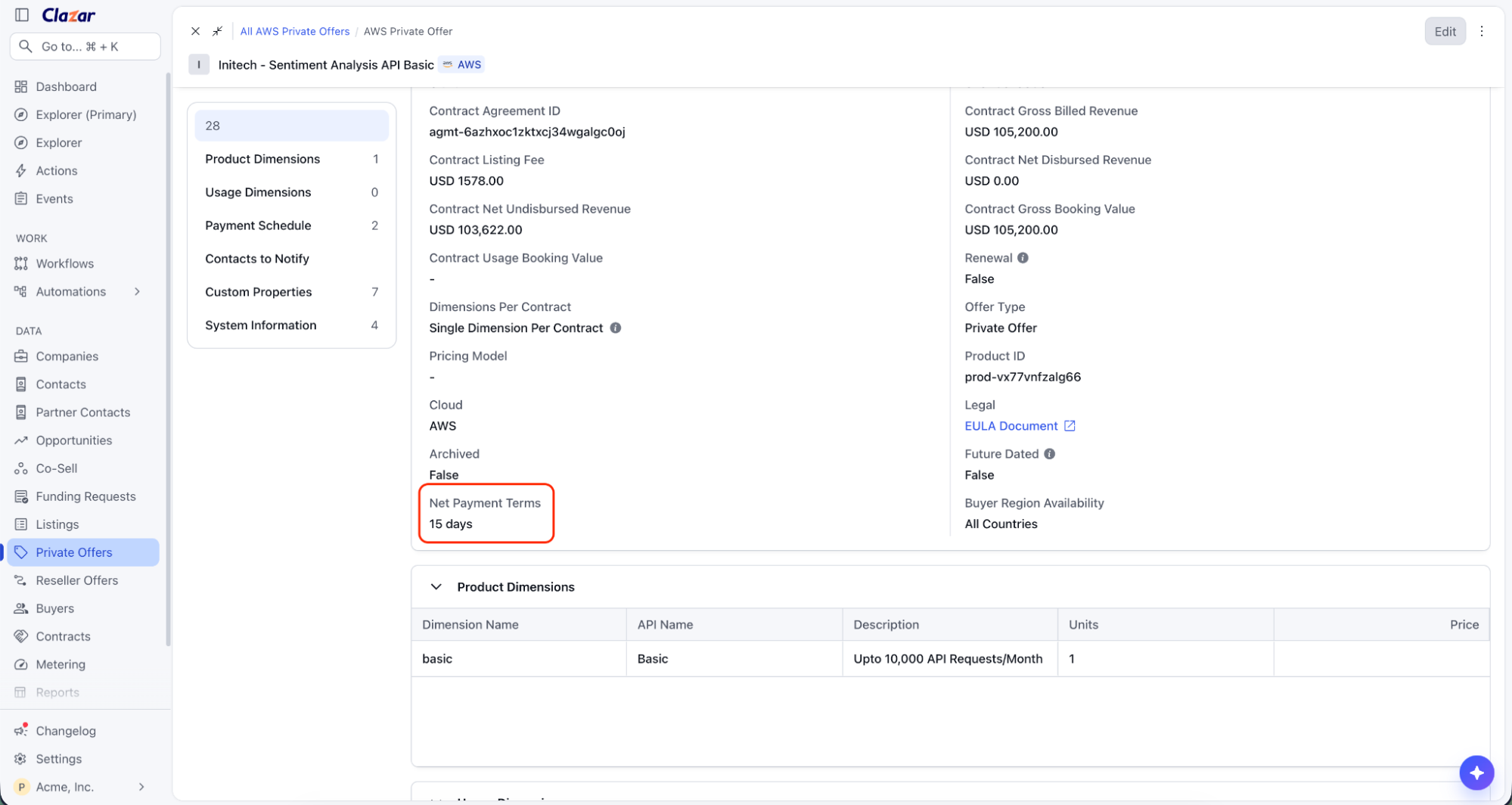
Clazar lets you set a contract duration of up to 12 years on AWS private offers and reseller offers, and build a payment schedule of up to 86 payments.
Pro Tip: If a deal needs to be unwound, you can also cancel AWS agreements and issue full or partial refunds from the contract detail page in Clazar, instead of raising an AWS support ticket.
Track offer status without checking the AWS portal
Once an offer is published, Clazar polls AWS for acceptance and agreement status and updates the record automatically. Slack and email notifications fire on offer movement, and internal team members or the buyer can be added as notification recipients at creation time.
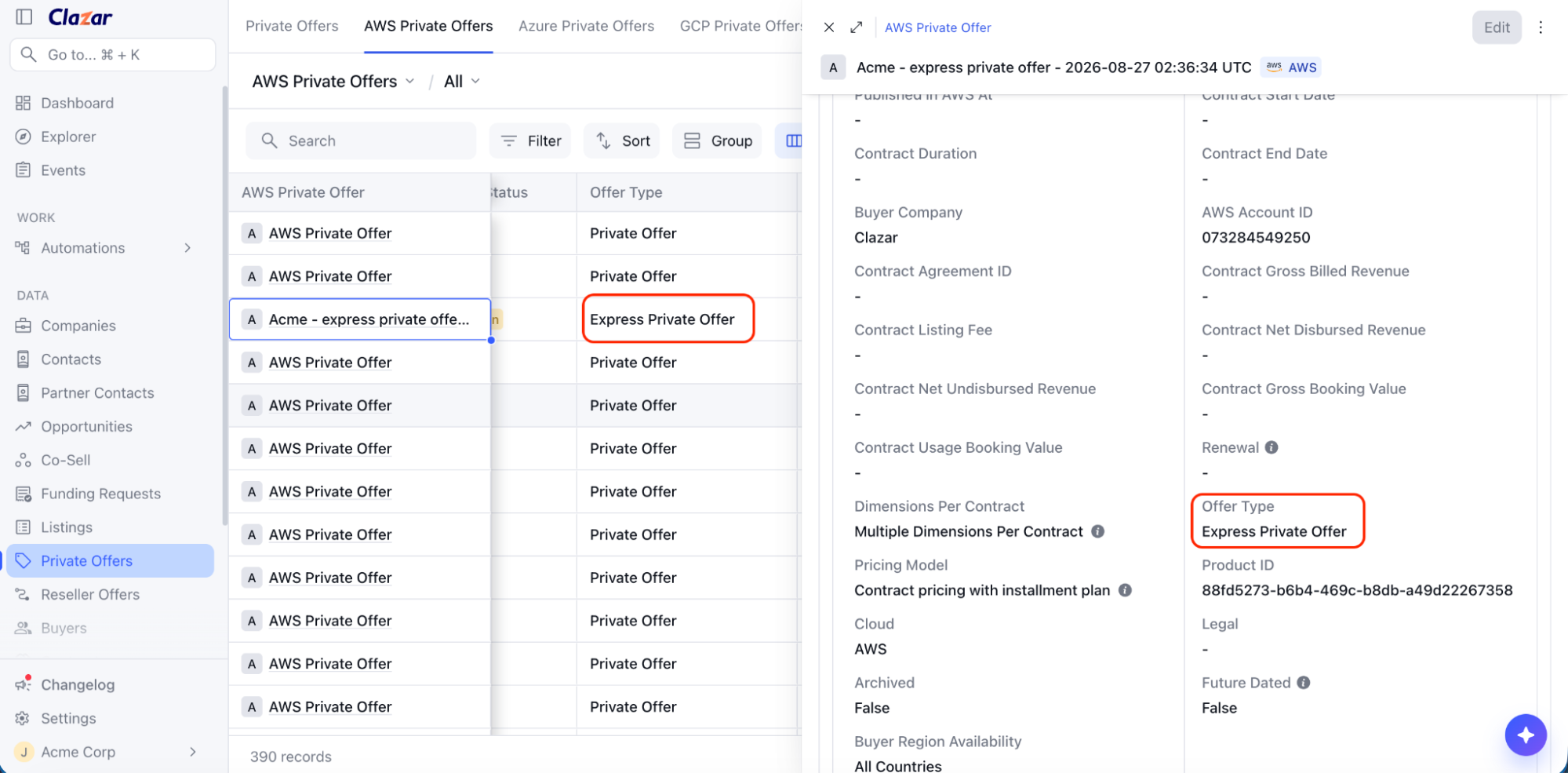
You can also track express private offers in Clazar. An express private offer is identified the moment AWS publishes it. Clazar tags it with a dedicated Express Private Offer type, and syncs it to Salesforce or HubSpot automatically. You can filter by offer type in Clazar's private offers list, APIs, and exports, and subscribe to webhook events for express offer creation and acceptance.
Pro Tip: The AWS-issued Offer PDF is downloadable directly from Clazar or from the CRM widget, so nobody needs to log into the AWS portal.
Manage and analyze offers across clouds in one view
For teams selling through more than one marketplace, Clazar normalizes private offer data into a common schema. Status, offer type, buyer name, buyer account ID, offer URL, renewal flag, and key dates are mapped onto a single model that works across AWS and other marketplaces. A query like "show me every published offer" runs against one view.
The raw, per-cloud status is still accessible for teams that need it. Clazar preserves that granularity alongside the normalized view.
And if you have a quick question about your private offers, you can also ask Clazar AI, the in-built AI assistant, or just prompt your own preferred AI assistant via the Clazar MCP Server.
Automate and scale private offer workflows with Clazar
Building offers by hand stops scaling somewhere around your first busy month. Clazar automates private offer creation from your CRM, with deal desk guardrails, and tracks express offers as a first-class type alongside your standard and reseller deals.
See how you can scale your AWS Marketplace operations with confidence and without the operational lift. Book a Clazar demo.
Frequently asked questions
What is the difference between a private offer and a public offer on AWS Marketplace?
A public offer is your listed price, visible to every AWS Marketplace buyer. A private offer has negotiated terms and is visible only to the buyer accounts you target.
Can I create a private offer on AWS Marketplace for an AMI or container product?
Yes. AWS Marketplace supports private offers for SaaS, AMI, container, machine learning, and professional services products. Express offers are the exception: they cover SaaS Contract and SaaS Contract with Consumption Pricing products only.
Who creates a CPPO, me or the partner?
The partner creates the buyer-facing offer. You authorize them and set the wholesale cost they build on top of.
Is an AWS express private offer the same as a fast-tracked standard offer?
No. A standard offer is assembled by you per deal. An express offer is generated by AWS from rate cards you set up in advance, qualified by an AI agent against criteria you configured, and capped by global maximums you set on contract value and discount percentage.
Does enabling express private offers affect my AWS co-sell visibility?
It can. Sellers with express offers enabled get an "EPO Enabled" badge visible to AWS's recommendation engine. The automated pricing delivery can improve responsiveness and conversion metrics, and the rate card setup itself forces listing completeness.
Can I track AWS express offers on a third-party platform?
Yes. Clazar identifies express private offers the moment AWS publishes them and tags them as a dedicated offer type in your private offers list, CRM, and reporting. Webhook events fire on creation and acceptance.