


Share
.svg)
.svg)
.svg)
What is Cloud GTM?
Cloud GTM combines sales, marketing, and partnerships to list, transact, and co-sell on cloud marketplaces, thereby reaching customers and unlocking a new revenue channel for Independent Software Vendors (ISVs).
Cloud marketplaces have become a core revenue engine, enabling cloud GTM teams to unblock deals with buyers’ committed spend, shorten sales cycles, and increase win rates.
At its core, Cloud GTM enables ISVs to:
- Sell where customers already procure (i.e., cloud marketplaces)
- Co-sell alongside hyperscaler field teams
- Unlock the budget pre-allocated to cloud providers (such as PPA on AWS or MACC on Azure)
- Accelerate deal velocity with pre-approved procurement paths
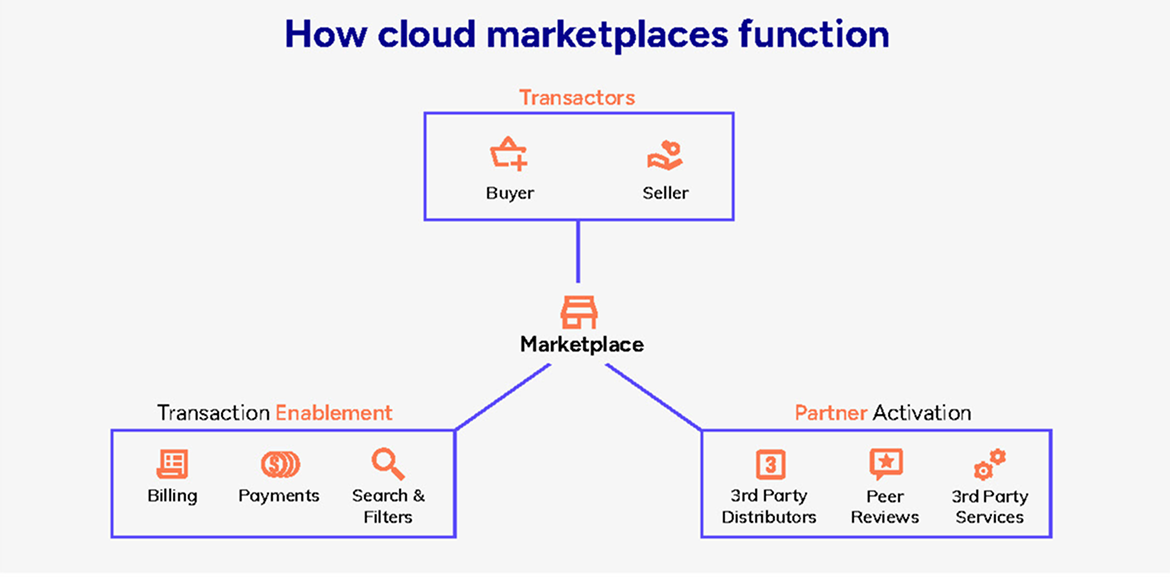
How cloud GTM differs from traditional GTM
Cloud GTM differs from traditional GTM mainly in where and how you sell. It is a more structured approach that enables the swift execution of commercial transactions.
Cloud GTM is built around hyperscaler ecosystems and marketplaces (AWS, Azure, Google Cloud, or Snowflake) and their co‑sell programs. At the same time, traditional GTM relies on direct sales and standard digital channels.
Cloud GTM uses buyers’ existing cloud commitments and marketplace procurement process to accelerate deals, whereas traditional GTM typically has to create budgets, vendor records, and contracts from scratch.
How is traditional GTM different from Cloud GTM
Why cloud GTM matters for ISVs
When executed properly, cloud GTM unlocks new procurement behaviors, accelerates sales cycles, and drives significant revenue growth for software companies.
Here’s why ISVs need to care and double down on cloud marketplaces as a new sales channel.
1. The new way buyers purchase
Enterprise buying behavior has evolved, and instead of lengthy vendor onboarding cycles, many buyers prefer to transact with hyperscalers.
By listing on cloud marketplaces, ISVs reach a broader enterprise customer base that relies on cloud providers for their software needs. More than 60% of SaaS companies acquire net-new customers through cloud marketplaces such as AWS, Microsoft, and Google Cloud.
For ISVs, procurement is the most significant friction point in enterprise sales, and it becomes dramatically easier once the product is listed on the marketplace. Cloud marketplaces offer pre-approved procurement paths, simplified contracting, the ability to draw down on committed spend,s and a single billing source.
This shift alone is turning cloud marketplaces into a default buying route for modern SaaS.
2. Accelerated sales cycle times
Cloud marketplaces significantly accelerate the sales cycle and improve deal win rates. Marketplace purchases often skip legal reviews, compliance checks, and multi-step vendor onboarding.
While cadence varies by company, many ISVs report that co-sell and marketplace-assisted deals move faster because cloud provider field teams are incentivized to drive execution.
In fact, many top-performing ISVs are 2x more likely to automate workflows (co-sell, approvals, offer creation), which improves win rates.
3. Larger and more strategic deals
Cloud GTM enables you to leverage committed cloud spend. Enterprises often reserve budget for their cloud providers, and the marketplace route lets them spend that on third-party software. That means larger, multi-year, or consumption-based deals tied to cloud usage.
Co-sell motions with hyperscaler field teams, which leads to joint pipeline development, warm intros, and buyer trust, all of which amplify deal size.
According to a recent Clazar study, many ISVs now generate over 20% of their total revenue through cloud marketplace channels.
4. New routes to revenue
Cloud GTM also opens doors that traditional SaaS sales can’t.
AWS customers have more than 3 million subscriptions from AWS Marketplace. Listing on AWS Marketplace, for instance, can get you in front of hundreds of thousands of buyers.
Co-selling with AWS/Azure/GCP reps, you gain visibility and access to partner-led or partner-attached opportunities. These new routes drive net-new pipeline from logos that might never engage through traditional outbound or inbound channels.
According to Omdia, enterprise software sales via hyperscaler marketplaces are projected to spring from ~$30B in 2024 to $163B by 2030, a CAGR of ~29%.
“Cloud marketplaces offer software vendors a dual value proposition. First, they provide ISVs access to a global, engaged customer base actively seeking solutions. Second, they foster strategic relationships with hyperscalers that grow more valuable over time. As your marketplace presence matures, you’ll find increased support, preferential pricing, and exclusive programs that can significantly impact your bottom line and accelerate growth. This symbiosis of value not only expands your reach but also enhances your competitive edge in an increasingly cloud-centric business landscape.”
Vince Menzione, CEO | Ultimate Partner
What are the key components of a cloud GTM framework
A cloud GTM framework is a plan specifically designed to launch cloud sales and co-sell motion with Hyperscalers such as AWS, Azure, and GCP.
The core components of a cloud GTM framework are:
1. Strategy and planning
A cloud GTM strategy helps ISVs determine “where” and “how” deals should close, based on buyer procurement preferences rather than just seller motion.
A few factors to consider:
Cloud-aligned ICP development
Defining your ideal customer profile isn’t just about industry or company size; it’s about understanding cloud-buying behavior. Your best ideal customer profile (ICPs) for cloud GTM are organizations with either:
- Large cloud commits
- Teams are already transacting through marketplaces
- Buyers who prioritize accelerated procurement
Knowing where a customer is in their cloud journey directly informs your listing strategy and co-sell positioning.
Ecosystem-centric value proposition
In cloud GTM, your messaging must appeal to both buyers and cloud partners.
How you position yourself should highlight what the product does, and how it helps customers optimize cloud spend.
Marketplace and cloud fit assessment
Instead of traditional competitive analysis, cloud GTM strategy asks:
- Where does your product fit within AWS, Azure, or GCP solution areas?
- Which marketplace categories and co-sell programs make sense?
- Are there ecosystem gaps you can uniquely fill?
Validating cloud GTM fit early ensures you build listings, offers, and partnership motions that hyperscalers will actually support.
Cloud-aware pricing and packaging
Cloud buyers purchase differently. Some want usage-based SKUs tied to cloud consumption, while others prefer committed private offers that align with annual or multi-year plans.
Planning pricing for marketplace transactions (public vs. private, usage vs. contract) becomes a strategic lever that affects win rates and deal velocity.
2. Execution and operations
Cross-functional cloud alignment
Cloud GTM brings sales, alliances, marketing, product, revOps, and finance into constant collaboration. For instance, the listing process might involve product engineering to do the heavy lifting, along with marketing to set up the listing content.
While the private offers process requires an AE to work with the deal desk and legal. Without cross-functional orchestration, cloud GTM breaks quickly.
Sales and marketing motions activate cloud GTM
The marketing and demand generation team enables internal sales/partnership teams, as well as cloud field teams, to sell with you.
This includes creating:
- Cloud-specific content and “better together” stories
- Joint campaigns with AWS/Azure/GCP
- Marketplace-oriented landing pages
- Co-sell enablement for sales teams
Sales execution also requires deal registration, account mapping, and developing a shared pipeline with hyperscalers.
Cloud buyer experience
Cloud procurement changes the customer journey. Onboarding, usage metering, billing, and renewals must be tied to marketplace workflows. A smooth experience, from private offer creation to fulfillment and invoice reconciliation, is what drives repeatable marketplace revenue.
This includes creating a custom registration page and integrating APIs to provision new accounts when a private offer is accepted automatically.
Automation, integrations, and operational tools
Cloud GTM is impossible to scale manually. ISVs must rely on:
- CRM + marketplace integrations such as Salesforce and HubSpot
- Co-sell data sync
- Private offer workflows
- Finance system integrations
- Cloud marketplace and co-sell analytics dashboards
This is where platforms like Clazar become essential, replacing spreadsheets with a cloud GTM operating system built for cloud marketplaces and partners.
3. Measurement and iteration
KPIs built for cloud motions
Cloud GTM success cannot be measured solely by traditional SaaS KPIs.
ISVs need cloud-specific metrics such as:
- Co-sell win rate
- Partner-sourced pipeline
- Marketplace ARR contribution
- Private-offer velocity
- Cloud field engagement scores
Cloud-centric feedback and optimization
Real-time feedback comes from cloud partners, marketplace performance, co-sell program data, and usage trends. Iterating on listing performance, offer structures, partner alignment, and revenue ops workflows ensures consistent revenue growth.
Process standardization across the cloud lifecycle
The most successful ISVs build repeatable processes around listings, offers, co-selling, deal operations, billing, and renewals.
Cloud GTM improves exponentially when every step from offer management to revenue recognition is templatized, automated, or integrated into a unified GTM operating system.
Who owns Cloud GTM?
Clear ownership of responsibilities is essential for accountability across the internal teams involved in a cloud GTM motion.
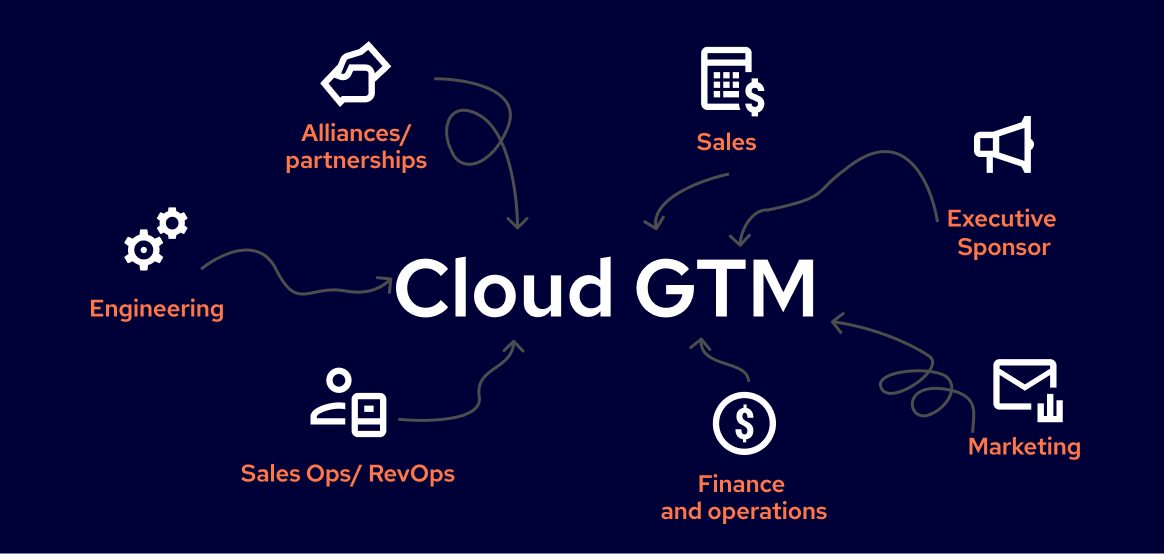
Key ownership roles in a cloud GTM strategy often include:
1. Executive Sponsor
Typically, the Chief Executive Officer (CEO), Chief Revenue Officer (CRO), or Chief Finance Officer (CFO), provides high-level sponsorship and ensures the cloud GTM motion is treated as a core revenue channel, not a side project.
They serve as the core decision-maker for budgeting, hiring a Cloud Alliance team, and other key matters.
2. Alliances/partnerships
Partner and alliance leaders are responsible for influencing revenue that flows in through building partnerships with Hyperscalers.
They need to drive cross-functional alignment, unlock pipeline expansion through co-sell, and track the impact of cloud GTM motion.
3. Sales
A sales leader is responsible for aligning the team to drive more deals via the marketplace route and also coaching them on co-selling with Hyperscaler sales counterparts.
A sales leader needs to drive the adoption of cloud GTM platforms such as Clazar and ensure that cloud sales workflows align with existing workflows.
They need to ensure compensation neutrality for sales reps on deals flowing through the marketplace, and not let the listing fee act as a disincentive.
4. Engineering
Responsible for building and maintaining the technical integrations with cloud marketplaces, ensuring the product is functional and adheres to the provider's technical guidelines.
5. Sales Ops/ RevOps
Manages the integration between internal systems (such as CRM) and the cloud provider's platform, ensuring data integrity, accurate reporting, and seamless co-sell workflows.
These teams operationalize the entire motion, which includes managing CRM hygiene, deal registration accuracy, account mapping, co-sell workflows, and influence attribution.
They make the motion predictable, repeatable, and measurable.
6. Finance and operations
Finance plays a critical role in turning cloud GTM into a legitimate revenue channel. They own pricing governance, revenue recognition, marketplace fee modeling, discount thresholds, and private offer policies.
Operations partners closely with finance to ensure processes are auditable, scalable, and integrated with internal systems.
7. Marketing
The marketing team ensures the marketplace listing effectively communicates value to prospects, aligns with the direct sales team's pipeline, and drives conversions.
They also craft the “better together” narrative with hyperscalers, develop partnerships, create co-marketing content, and produce collateral that helps cloud representatives understand and effectively champion the product.
As the channel matures, many ISVs hire dedicated partner marketing specialists to support marketplace campaigns and drive demand through cloud channels.
KPIs for measuring cloud GTM success
Here is a list of KPIs ideal for measuring the success of your cloud GTM strategy:
1. Deal size and speed
- Average contract value (ACV): Track whether your marketplace and co-sell deals are growing in ACV. It's a positive sign that your cloud GTM and co-sell efforts with AWS, Azure, and GCP are delivering ACV above average.
- Deal velocity: Measuring how quickly deals close through cloud channels compared to your traditional GTM is another key KPI. Faster deal cycles are a signal that procurement friction is dropping, and this could be due to streamlining legal formalities and unblocked deals owing to PPA and MACC availability.
2. Co-sell involvement & win rate
- Count the number of co-sell engagements with cloud provider sellers, lunches, or joint pipeline sessions. This is a leading indicator of relationship health.
- Measure the win rate on opportunities influenced by cloud sellers. If this rate is improving, it shows that your co-sell motion is effective.
- Track the ratio of inbound vs. outbound co-sell opportunities. A rising inbound rate is a strong signal that CSPs see you as a valuable partner.
3. Revenue attribution
- Marketplace ARR: The percentage of your Annual Recurring Revenue (ARR) that’s contributed by cloud marketplace transactions. As your Cloud GTM matures, this should rise.
- Partner-sourced revenue: Revenue from deals that partners (or CSP field teams) originated directly.
- Partner-influenced revenue: Revenue from deals where partners played an active role, maybe at the introduction stage or co-sell, even if they didn’t originate the lead.
4. Partnership engagement and marketing
- The number of joint co-marketing activities, such as webinars, events, and content with cloud partners, is a proxy for partnership activation and alignment.
- The conversion rate of these joint leads to opportunities or closed deals measures the quality and effectiveness of partner-enabled demand.
5. Partnership momentum over time
Measure how partnership-based metrics evolve quarter over quarter:
- Is the co-sell win rate increasing?
- Are referral rates growing?
- Is the mix of partner-influenced vs. sourced revenue improving?
These trends highlight whether your Cloud GTM motion is truly scaling.
6. Executive-level impact
Use your KPIs to craft a compelling narrative for executives. Show them how cloud partnerships affect not just deals, but your strategic positioning and long-term ARR mix.
Having a reliable, complete, and real-time view of your cloud marketplace performance requires an analytics platform. Clazar Analytics helps track bookings, billings, disbursements, co-sell engagements, and metered usage across AWS, Azure, and GCP in one combined dashboard.
Implementation roadmap: A phased cloud GTM plan
Cloud marketplaces are exploding, and ISVs that treat Cloud GTM like a side project are the ones getting left behind.
Let’s look at how ISVs can build a scalable Cloud GTM foundation with the right people, processes, KPIs, and automation.
Phase 0: Prerequisites and kickoff
- Define your cloud provider strategy, prioritizing which hyperscalers to use (AWS, Azure, or GCP), and align it with where your ICP allocates its cloud budget.
- Run a Cloud GTM maturity assessment to benchmark your starting point.
- Collaborate with internal teams and leadership to set objectives, timelines, and early milestones. Establish your pipeline targets, expected marketplace ARR, co-sell metrics, and private offer volume.
- Plan how marketplace data will flow into your stack (CRM, BI, data warehouse).
Phase 1: Marketplace listing setup
- Define which SKUs will be public vs private.
- Build and validate pricing/packaging SKUs that map to usage dimensions, cloud consumption, or commitment levels.
- Lay your complete legal groundwork from T&Cs, terms, security/compliance documentation, to refund policies.
- Configure tax, invoicing, and fulfillment routing as per cloud-provider-specific marketplace requirements.
- Build marketplace integrations, then submit your listing to the respective cloud.
You can leverage Clazar to streamline and fast-track the listing process. With a Clazar listing expert, you will never miss any provider-specific requirements, and they can surface compliance issues early, reducing back-and-forths.
Phase 2: Offer management
Once your listing is live, you move to the next step of the cloud GTM journey:
- Start creating private offers for potential customers, especially enterprise buyers.
- Configure custom terms, buyer-specific pricing, and volume or commitment-based discounts.
- Set up approval workflows: involve finance, legal, and RevOps for sign-off.
- Define and implement fulfillment logic: how metered usage, invoicing, and delivery will work once a private offer is accepted.
To make the process more effective, leverage Clazar’s private-offer workflow automation.
This automates approvals, routes deal notifications, and minimizes manual handoffs, so offers don’t stall, and teams don’t waste hours chasing signatures.
Phase 3: Co-Sell and partner motion
The next phase is to scale cloud GTM by working with cloud field sellers via your co-sell motion:
- Register deals with your cloud partners (AWS ACE, Microsoft Partner Center, Google PSC).
- Conduct account-mapping with cloud seller teams to identify overlap and co-sell targets.
- Build an MDF / co-marketing plan to support the early co-sell pipeline.
Use Clazar’s Automation Builder to sync co-sell data between the marketplace and your CRM. Automatically route tasks (such as follow-up reminders, co-sell handoffs) to the right reps. This reduces manual admin and ensures consistency in follow-up.
Phase 4: Metering
Once your customers start leveraging your product, you need to build flows to meter and bill them correctly, especially for usage-based products.
- Begin metering/consumption tracking, especially for usage-based or consumption offers.
- Validate that customers are provisioned correctly and usage is being reported or tracked.
- Close with cloud-approved documentation and ensure deals are linked correctly in your systems.
Choose a cloud GTM platform like Clazar that integrates with metering platforms such as Metronone and Airbyte.
Phase 5: Billing, invoicing, and revenue recognition
Launching and extending offers is one part of cloud GTM. Another equally important step is tracking the cloud marketplace and co-sell revenue.
- Set up marketplace disbursement tracking to monitor payments coming from cloud providers.
- Define your revenue recognition policy for marketplace deals, including private offers.
- Reconcile marketplace payouts, fees, and net revenue with your finance system.
Use Clazar’s integration with finance systems (e.g., ERP / accounting software) to produce accurate reconciliation reports. Automate revenue workflows so finance doesn’t have to manually reconcile every marketplace transaction.
Phase 6: Analytics, reporting & optimization
- Build a Cloud GTM dashboard capturing key metrics: ARR by marketplace, co-sell win rate, private-offer conversion, and pipeline velocity.
- Conduct cohort analyses (by buyer type, cloud, deal source) to spot trends.
- Evaluate margins for marketplace deals, factoring in provider fees and discounting.
- Monitor renewal risk and early expansion signals to inform product and sales strategy.
Leverage Clazar’s Analytics to centralize marketplace data into a single combined view with the ability to export to your own data warehouse. This gives you a unified view across clouds and deal types, enabling consistent, high-quality reporting.
Phase 7: Renewals & expansion (Ongoing)
- Put auto-renewal rules in place for marketplace customers.
- Develop upsell and expansion offers (multi-product, higher-tier SKUs) specifically for cloud buyers.
- Engage cloud field reps and co-sell teams to drive expansion conversations.
Use Clazar automation builder for renewal cadences, trigger expansion playbooks based on usage trends, and orchestrate upsell workflows. The system helps you run expansions consistently without manually triggering each deal.
Common cloud GTM mistakes and how to fix them
Cloud marketplaces have become one of the fastest-growing distribution channels for software companies. Yet even as more teams embrace AWS, Azure, and Google Cloud listings as part of their revenue engine, most still treat cloud GTM as an experimental side channel.
The result is slow traction, missed co-sell opportunities, and deals that take far longer than they should.
Here are the most common cloud GTM challenges and practical fixes that help teams grow faster with marketplaces and co-sell.
Mistake 1: Treating cloud marketplaces as a simple procurement alternative
Many teams approach marketplaces as nothing more than an easier way for buyers to purchase software. While simplified procurement is a major benefit, marketplaces are much more valuable when used as a strategic cloud GTM engine.
Fix: Position the marketplace as a revenue channel. Align sales and alliances around a shared GTM motion that includes marketplace private offers, cloud seller alignment, and incentives. Enable your sales team with clear playbooks for when and how to move deals to the marketplace instead of leaving it to chance.
Mistake 2: Underinvesting in cloud seller relationships
Cloud GTM success is driven by humans behind the scenes. Cloud sellers prioritize solutions that help them meet their own quotas, but many companies send a single introductory email and hope for the best.
Fix: Create a repeatable cloud seller engagement program. Share mutual customer targets, prepare co-sell artifacts, and communicate wins proactively through win-wires. When cloud sellers clearly see how your product helps them meet their goals, they bring you into more deals.
Trunal Bhanse, CEO of Clazar, highlights how you can accelerate the co-sell motion by working effectively with cloud sellers in his recent LinkedIn post.
Mistake 3: Listing before you have a real plan
Some teams rush to get listed, only to discover they have no pricing strategy, no internal process for marketplace deals, and no alignment with finance or ops. This slows down early results and frustrates sellers.
Fix: Build a marketplace readiness plan before publishing. This includes deal routing, compensation rules, billing workflows, and offer strategy. A structured foundation ensures your first 10 marketplace deals close smoothly and that your team remains confident.
Mistake 4: Not leveraging cloud partner Incentives
Cloud providers offer incentives and programs that dramatically accelerate deals, but many companies never tap into them due to a lack of awareness or process. AWS’s List and Sell or ACE-CRM integration program offers incentives to cloud sellers to adopt and accelerate their cloud GTM journey.
Fix: Train your team on the incentives available across each CSP. Ensure your CRM is connected to cloud co-sell systems so opportunities are registered early. Work with industry experts, such as Clazar CSMs, to unlock incentives available across different cloud providers.
Mistake 5: Neglecting post-listing marketing
A surprising number of companies launch their listing and then never promote it. Without awareness, you miss both inbound traffic and vital visibility into your cloud partners.
Fix: Build a post-launch marketing plan. This includes marketplace-focused webpages, sales enablement materials, co-branded campaigns, and regular updates for cloud partner teams. Your listing becomes more visible, which leads to more opportunities.
Cloud GTM is no longer optional for modern SaaS companies. When done well, it becomes a predictable and efficient channel for new revenue, accelerated deal cycles, and stronger partnerships with AWS, Azure, and Google Cloud.
Mistake 6: Not automating grunt work
Spreadsheets work in the first phase of your marketplace journey. Still, they collapse under scale: co-sell statuses fall out of sync, private-offer approvals get lost in email threads, attribution becomes inconsistent, and leadership loses confidence in the data.
Manual ops also create dependency on a few individuals, making GTM fragile and difficult to audit.
Fix: Cloud GTM requires coordination across ACE (AWS), Partner Center (Azure), Partner Sales Connect (GCP), as well as your CRM and marketplace backend.
Utilize a tool like Clazar’s Automation Builder to integrate these systems. Hence, actions flow automatically, deal registrations sync to the CRM, listing updates propagate across marketplaces, co-sell status changes trigger RevOps workflows, and private-offer steps are pre-built into guided playbooks.
This turns a previously ad-hoc process into an orchestrated, repeatable motion that reduces handoffs and speeds up co-sell execution.
With automation, Cloud GTM transitions from a reactive, manual approach to a proactive, system-driven one. Workflows run on their own, reporting becomes trustworthy, and teams spend time selling, not updating trackers.
What is a Cloud GTM platform?
A cloud GTM platform is a technology solution that helps software vendors sell their products through cloud marketplaces like AWS, Google Cloud, and Microsoft Azure.
These platforms streamline the complex processes of listing products, transacting with customers, and co-selling with cloud providers by centralizing offer management, automating workflows, integrating with CRM and finance systems, and providing data analytics to build a scalable cloud GTM engine.
Why Cloud GTM platforms matter
The cloud marketplace ecosystem is expanding quickly as more buyers shift budgets to commit-based spending with AWS, Azure, and GCP.
This creates a powerful opportunity for software sellers, but operating across three marketplaces introduces complex operational, technical, and GTM challenges.
Cloud GTM platforms, such as Clazar, simplify these processes, allowing teams to accelerate revenue rather than spend time on administrative work.
How Cloud GTM platforms work
Below is a clear breakdown of the core functions that every cloud-powered go-to-market team relies on.
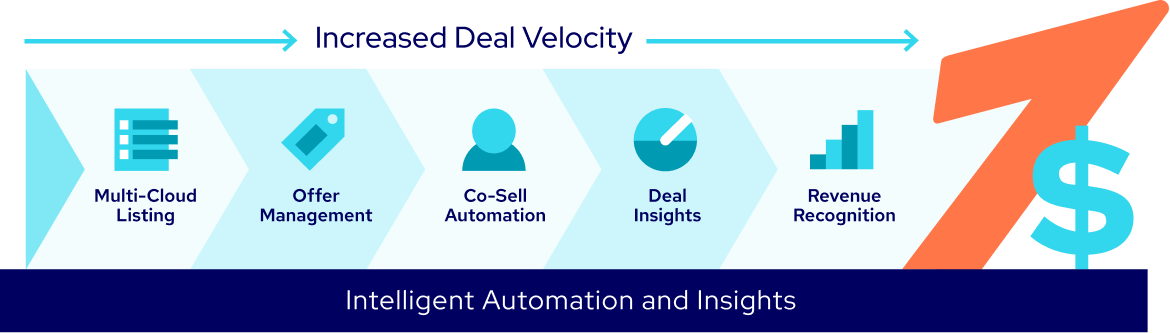
1. Listing and offer management
Cloud GTM platforms offer a unified interface for listing products across multiple marketplaces, managing pricing, publishing private offers, and processing transactions.
Instead of navigating three separate consoles, sellers control everything from one place.
2. Co-selling and partnerships
Cloud GTM platforms streamline co-selling by helping vendors identify customers with cloud commitments, register opportunities, and collaborate with partner teams from AWS, Microsoft, and Google.
Strong co-sell alignment leads to faster deal velocity and better cloud partner support.
3. Data and Analytics
A cloud GTM platform uses marketplace and CRM data to highlight buyers who prefer cloud procurement, signal intent, forecast revenue, and track co-sell performance.
Visibility into the cloud-influenced pipeline is critical for both sales and executive teams.
4. Automation
Cloud GTM operations involve dozens of manual steps. Automation helps teams route approvals, send alerts, generate offers, update CRM objects, sync billing data, and manage renewals.
This reduces errors and unlocks more time for selling.
5. Integrations
Cloud GTM platforms typically integrate with key business systems, such as Salesforce, NetSuite, Snowflake, and BigQuery, as well as communication and collaboration tools.
This creates a seamless workflow for sales, finance, and operations teams, eliminating the need for manual data entry.
What to look for in a Cloud GTM Platform
Choosing the right platform determines how fast your company can scale marketplace revenue.
Must-have capabilities
- End-to-end cloud GTM capabilities from listing to offer to renewal
- Native marketplace integration for AWS, Azure, and GCP
- Automation engine with event-based workflows, approvals, and alerts
- Integrations with CRM, finance, data warehouses, and metering systems
- Governance with role-based access, audit trails, and security compliance
- Fast time to value through enablement and implementation support
Clazar is built to operationalize the full cloud GTM lifecycle. With marketplace native integrations, an automation builder that eliminates manual work, and deep analytics at every stage of the funnel, Clazar helps revenue teams scale cloud marketplace sales with confidence.
Which is the best cloud GTM platform in 2026
As cloud marketplaces become a significant revenue channel for SaaS companies, several platforms help teams manage listings, private offers, co-selling, billing, and analytics.
Here is a concise breakdown of the leading cloud GTM platforms:
1. Clazar
Best overall: Full lifecycle cloud GTM automation
Clazar delivers end-to-end support across AWS, Azure, and GCP for listing, offers, co-sell, billing, renewals, and analytics.
Its Automation Builder and deep integrations with Salesforce, NetSuite, and data warehouses remove manual work and create a scalable cloud GTM engine.
Why Clazar leads
- Complete lifecycle coverage
- Native marketplace connectivity
- Powerful automation
- Unified data and analytics
- Fast implementation and enterprise-grade governance
2. Tackle
Good for initial listing setup
Strengths: Smooth listing experience
Considerations: Limited automation out of the box
3. Suger
Good for marketplace transactions and metering
Strengths: Simple UI, private offers, and metering support
Considerations: Might require manual upgrades to the CRM package for every cloud change & a less robust automation layer
4. Labra
Suitable for co-sell and opportunity registration
Strengths: Good co-sell workflows and deal registration
Considerations: Limited billing and analytics depth
Why Clazar is the best choice for cloud GTM
Among all platforms, Clazar is the only solution that unifies listing-to-renewal in a single system while automating every operational step.
For companies seeking predictable, scalable cloud marketplace revenue, Clazar is the clear leader.
What are some successful cloud GTM case studies?
1. VulnCheck

VulnCheck went live on AWS Marketplace within just three weeks of choosing Clazar, with zero engineering overhead. Within 24 hours of publishing their private offers, VulnCheck closed multiple six-figure deals.
2. Vectra
.png)
Vectra experienced a 2.5x year-over-year growth on AWS Marketplace and a 6x year-over-year growth on Azure Marketplace. Clazar's co-sell automation processes thousands of ACE co-sell registrations automatically, saving the partnership and revenue operations teams hundreds of hours.
.png)
.svg)

%20(1).png)
.png)

.png)
.png)