


.png)
.svg)
.svg)
.svg)
.png)
According to the data we gathered for our State of the Cloud Marketplace & Co-Sell research report, one thing is clear. Co-sell is one of the biggest reasons SaaS companies list on cloud marketplaces.
In fact, 56% of ISVs say co-sell and co-marketing opportunities with hyperscalers are a primary motivator for listing on AWS, Azure, or GCP. It makes sense. Cloud partnerships can open doors to new pipeline, bigger deals, and faster sales cycles. Today, 71% of SaaS companies are actively participating in co-sell motions, and 58% of those report higher win rates on marketplace deals.
However, while most teams believe in the value of co-selling, very few have cracked the process.
The ones that are winning with co-sell are building real infrastructure to make it a seamless part of how they sell every day. In this blog, we’ll show you how to equip your revenue and partnership teams with the support they need to turn co-sell into a repeatable revenue-earning machine.
TL;DR
Co-selling with cloud marketplaces (AWS, Microsoft Azure, and Google Cloud) can increase win rates and accelerate enterprise deals. However, most teams struggle with manual submissions, disconnected partner portals, and poor visibility.
The companies that scale co-sell successfully:
- Centralize co-sell inside their CRM
- Eliminate errors with intelligent mapping
- Automate opportunity submissions and updates
- Measure pipeline and revenue influence
According to our latest research, 58% of SaaS companies report higher win rates on marketplace deals, but only 32% have structured co-sell processes. The difference is infrastructure.
What is co-selling with hyperscalers?
Co-selling is a joint sales motion where a SaaS provider collaborates with the field teams of a cloud provider, such as AWS, Microsoft Azure, or Google Cloud, to identify, influence, and close business deals together.
It typically involves:
- Registering opportunities in cloud partner portals (e.g., AWS ACE, Microsoft Partner Center)
- Engaging hyperscaler field sellers and aligning on shared accounts
- Driving joint customer conversations
- Closing deals through marketplace or standard procurement
Read More: A Complete Guide On Co-selling
Why does co-selling break down for many teams?
Despite strong adoption, execution is where co-sell with hyperscalers fails.
Only 32% of companies have structured, proactive field cadences in place. The rest are stuck in "execution debt". In fact, 51% of SaaS companies cite complexity as the primary scaling blocker.
Some of the common reasons for this include:
- Partner portals that don’t sync with Salesforce or HubSpot
- Manual opportunity submissions
- Slack threads chasing missing fields
- No visibility into deal influence
- No clear measurement of co-sell ROI
Pro Tip: When co-selling with cloud marketplaces, aligning with hyperscaler priorities helps open more doors for ISVs.
Bonus Resource: Learn how top cloud sales teams are automating their co-sell workflows across AWS, Azure, and GCP.
How to scale co-sell successfully: A 4-step framework
At Clazar, we’ve seen many companies come to us with the same problem: a co-sell motion that doesn’t seem to work, despite every effort. Here’s what we advise them, and how Clazar’s platform plays a role.
1. Centralize co-sell with hyperscalers within your CRM
Most teams are used to co-selling with cloud marketplaces being a fragmented, portal-hopping process. Often, your reps are stuck toggling between the different hyperscaler partner portals and the CRM just to register opportunities. Tracking them is a whole other complex tale as well.
To ensure co-sell success, ensure that co-sell opportunity creation happens inside your CRM.
This saves sales and partner teams hours each week by eliminating context switching and easing deal collaboration with cloud providers. When co-sell lives inside the CRM, adoption increases and errors decrease.
How Clazar helps
With Clazar, co-selling becomes native to your CRM, whether you use Salesforce or HubSpot. And this isn’t just for one cloud provider. It’s for all three hyperscalers: AWS, Azure, and GCP. You teams can -
- Create AWS, Azure, or GCP co-sell opportunities in a few clicks directly from Salesforce and HubSpot
- Auto-fill forms with data pulled from the CRM
- Sync opportunity data bi-directionally with cloud partner portals
- Trigger co-sell workflows based on your own sales stages
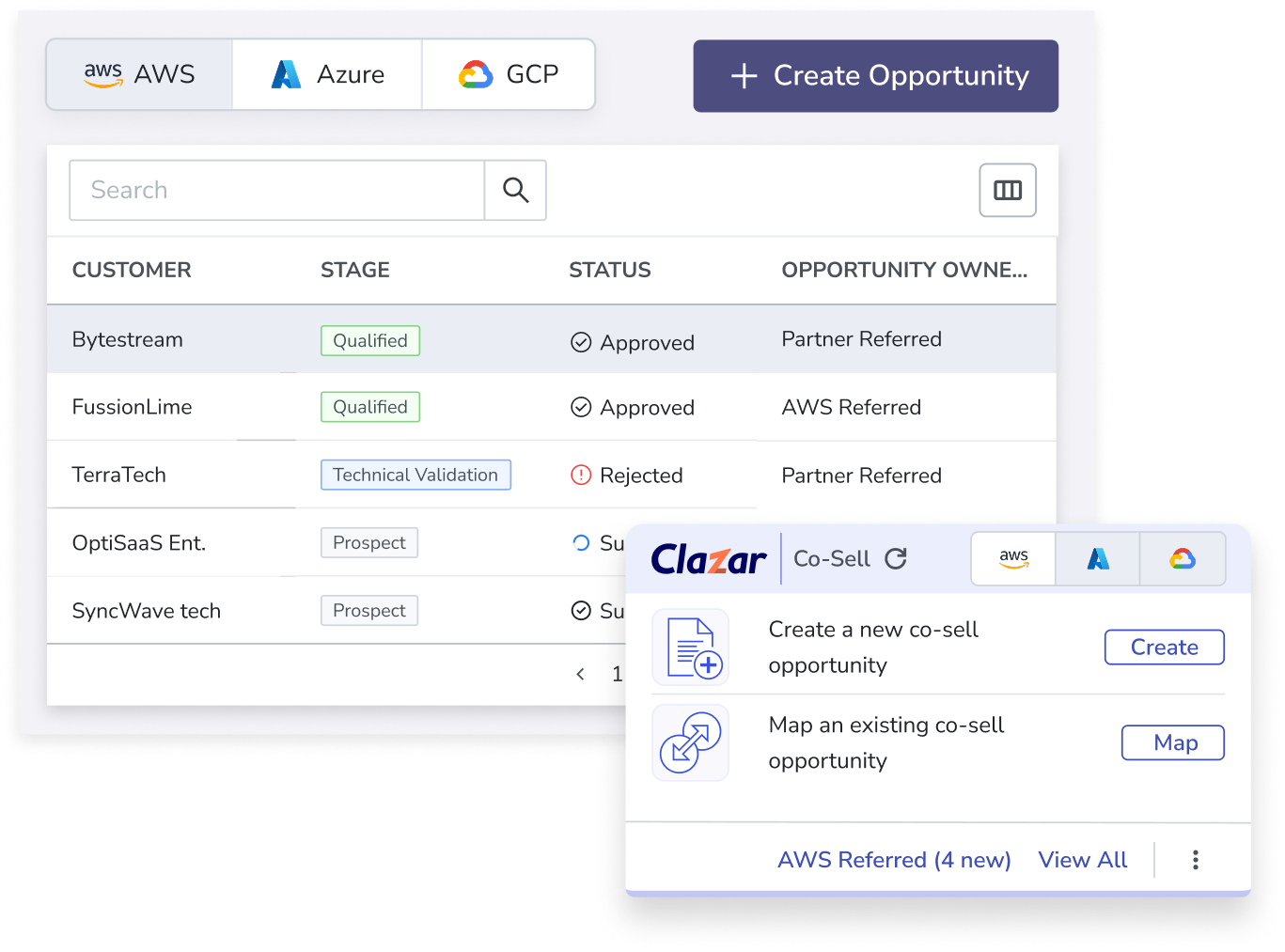
Sisense built co-sell into their CRM and automated AWS ACE registrations with Clazar to grow their marketplace revenue 3X.
2. Eliminate submission errors with intelligent mapping
AWS, Azure, and GCP forms rarely match your CRM data model. Manual mapping can lead to errors, delays due to rework and clarifications, and outright rejections.
With auto-mapping, your submissions go in clean and correct the first time, minimizing delays, rejections, and follow-ups from cloud teams.
How Clazar helps
Clazar supports custom field mapping, custom properties, and even data transformations to fit cloud-specific formats for all three hyperscalers: AWS, Azure Marketplace, and GCP.
For example:
- Pull a NetSuite ID from Salesforce and map it to a custom AWS co-sell field
- Compute a custom project description based on internal data
- Auto-map HubSpot deal fields to Microsoft Partner Center forms
Vectra chose Clazar to enable bulk registrations and automate field mapping, allowing every qualified SaaS deal to be submitted quickly and consistently.
Also Read:The definitive guide to cloud GTM
3. Automate your co-sell workflows
Manual co-sell management is one of the biggest execution bottlenecks GTM teams face. Sellers and RevOps spend hours taking CRM data and manually pushing it into partner portals like ACE. Time that should be spent closing deals, not chasing fields.
Automation should handle:
- Creation and updation of co-sell opportunities
- Status sync between CRM and partner portals
- Notifications for errors
- Workflow-based triggers (e.g., stage progression)
Automation enables companies to scale from hundreds of opportunities per year to hundreds per month, without adding headcount.
How Clazar helps
With Clazar, automation handles the heavy lifting. Teams using Clazar can:
- Auto-create co-sell opportunities based on CRM triggers
- Submit opportunities in bulk without sacrificing oversight
- Sync CRM and cloud portal data bidirectionally to avoid any confusion
- Automate common actions like ACE acceptance or sales stage progression with Salesforce Flows or HubSpot Workflows
- Get notified via Slack or email when there’s an error or pending action
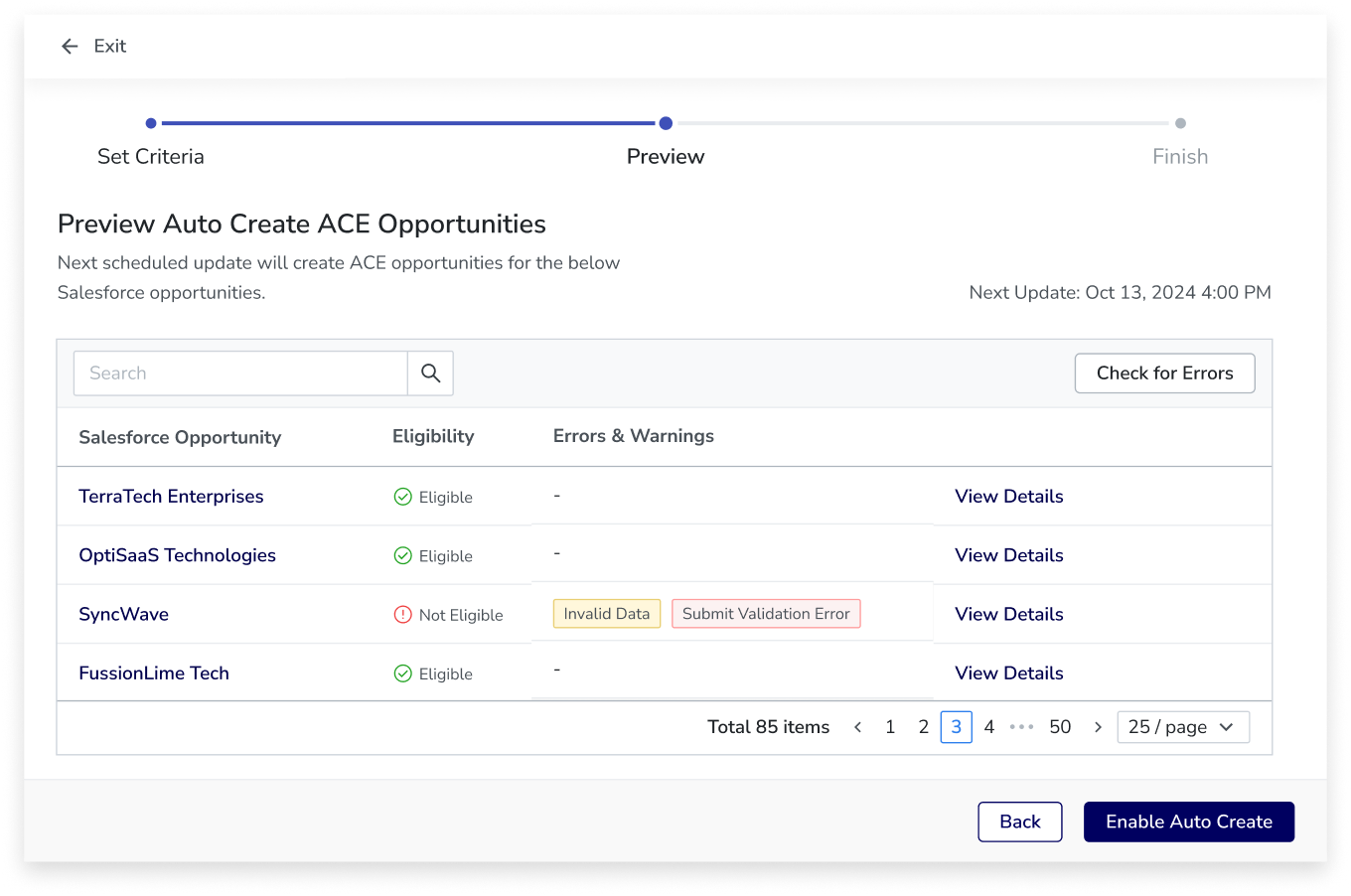
The best part? Set everything up in minutes with Clazar’s no-code automation UI—no engineering support needed!
Learn how Clazar’s auto-create feature accelerates cloud co-sell momentum by automating deal registration for sales teams.
4. Measure impact with co-sell dashboards that give real insights
Most teams struggle to get visibility into their marketplace pipeline, submission-to-close conversion rates, and other essential data that help them quantify the outcomes of their co-sell efforts.
Co-sell becomes strategic when it becomes measurable.
High-performing teams track:
- Co-sell submissions by cloud and quarter
- Referral acceptance rates
- Revenue influenced by hyperscalers
- Rep-level engagement
How Clazar helps
With Clazar’s built-in analytics and custom objects written back to your CRM, you finally get full visibility into your co-sell pipeline:
- Co-Sell Dashboard: Track submissions and referrals by cloud partner and quarter
- AWS Contact Dashboard: See which AWS reps are influencing your deals
- Custom views in HubSpot or Salesforce: Use co-sell data in native reports and workflows
You can finally show and improve the impact of your co-sell motion, without waiting for cloud partners to send you data.
.png)
Co-sell shouldn’t feel like extra work. With Clazar, it doesn’t
The most successful cloud partnership teams aren’t working harder. They’re working smarter with infrastructure that makes co-sell part of the core GTM process. When you reduce the operational drag, you unlock the strategic upside: bigger deals, faster sales cycles, deeper cloud partnerships, and ultimately, more revenue.
That’s the shift we’re seeing across Clazar customers, from SaaS startups just starting their cloud partnership journey to scaled public companies driving hundreds of millions in co-sell pipeline.
Here’s what a happy customer notes in a G2 review:
“Clazar has made it significantly easier to operationalize our AWS co-sell motion by providing a seamless connection between our CRM and ACE.The automatic synchronization of opportunities, partner metadata, and pipeline updates has saved our team hours of manual work and improved accuracy in reporting. The dashboards and workflow visibility are particularly helpful.”
If you’re ready to make co-sell your competitive edge (without the chaos), we’d love to show you how. Book a 1:1 walkthrough to see it in action.
Top FAQ's
- What is AWS co-sell?
AWS co-sell is a joint sales process where ISVs register opportunities in AWS ACE, collaborate with AWS field sellers, and work together to close customer deals.
2. Why does co-sell break down for most teams?
Because the process is traditionally messy and manual:
- Partner portals don’t sync with Salesforce/HubSpot
- Reps chase missing fields via Slack/Email
- No visibility into status, influence, or ROI
- No structured field cadence (only 32% of companies have one!)
Teams believe in co-sell, but execution complexity blocks scale.
3. How does Clazar fix the co-sell execution problem?
Clazar helps you efficiently scale co-sell execution by embedding it directly into your CRM and automating everything that slows reps down:
- Create AWS, Azure, and GCP co-sell opportunities without leaving Salesforce or HubSpot
- Auto-fill all required fields
- Sync updates both ways between CRM ↔ partner portals
- Trigger co-sell workflows based on your own sales stages
It becomes part of your natural selling workflow, not an extra step.
4. How does Clazar reduce submission errors?
Clazar supports:
- Custom field mapping
- Custom properties
- Automatic data transformations
- Internal → cloud-specific formatting
- Auto-filling CRM data into cloud forms
This means cleaner submissions and fewer rejections, clarifications, or delays from cloud teams.
5. How does Clazar help companies scale co-sell without adding headcount?
Clazar helps companies routinely go from a few hundred co-sell opportunities per year to hundreds per month. This becomes possible due to automation that eliminates:
- Manual submissions
- Data cleaning
- Portal chasing
- Status checking
- Partner communication gaps
Teams shift from administrative tasks to revenue-producing activities.
6. How do you track co-sell ROI?
To effectively track the ROI of your co-sell activities, ensure you can measure:
- Submitted opportunities
- Accepted referrals
- Influenced revenue
- Win rates
- Pipeline sourced by cloud partners
All this data should be available in your CRM.


.png)
.png)
.png)