

If your co-sell acceptance rates are flat or your submissions keep stalling without hyperscaler engagement, the issue probably isn’t your product or your deal size. It’s targeting. Buyer intent signals give your team a way to identify which accounts in your pipeline have the cloud spend structure, cloud marketplace history, and engagement patterns that make a co-sell submission worth the cloud provider’s time.
This guide breaks down the signal types, explains how propensity-to-buy scores work, and walks through how to put them to work in your sales workflow.
TL;DR: Most ISVs submit co-sell opportunities blind. They don't know which accounts have active cloud commitments, which ones have bought through a marketplace before, or which ones are actively researching solutions. Buyer intent signals and propensity-to-buy (P2B) scores change that. They surface which accounts in your pipeline are most likely to transact through AWS Marketplace or Microsoft Marketplace, so your sales and alliances teams can prioritize the right deals, engage hyperscaler sellers with confidence, and stop wasting co-sell submissions on accounts that were never going to buy that way.
What are buyer intent signals in cloud marketplace sales?
Buyer intent signals are observable behaviors and data points that indicate an account is actively considering a purchase. In general B2B sales, that might mean a prospect visiting your pricing page or downloading a comparison guide. In cloud marketplace sales, the signals are more specific, and more valuable, because they tell you not just whether a buyer is interested, but how they're likely to buy.
Three categories matter here.
First-party signals: what your own systems tell you
These are buyer intent signals that come from your CRM, product, and website. An account that's been in your pipeline for 60 days, has had three discovery calls, and whose champion just forwarded your pricing to procurement — that account is showing intent. The signals include deal stage progression, email engagement, product trial activity, and content downloads.
While first-party signals are strong on conviction, they’re weak on marketplace readiness. They tell you the buyer is interested in your product. They don't tell you whether that buyer has $2 million in unspent AWS committed spend waiting to be burned down.
Cloud provider signals: what the hyperscaler knows about the buyer
This is where marketplace-specific intelligence lives. AWS and Azure track engagement at the account level and make that data available to ISV partners through propensity scores and engagement metrics.
AWS engagement scores reflect how actively an account interacts with AWS Marketplace. It is based on actions like listing views, offer evaluations, past transactions, and participation in certain AWS programs. Azure MACC eligibility tells you whether the account has a Microsoft Azure Consumption Commitment that they can draw down through marketplace purchases.
These buyer intent signals are not available otherwise through your CRM or a third-party enrichment tool. They originate with the cloud provider, and they're the most marketplace-specific predictor of whether a buyer will transact through the marketplace.
Third-party signals: what the broader market reveals
Review site activity on G2 or TrustRadius, competitor comparison views, category research on analyst sites, and job postings for a cloud or partnerships function can all add context. Intent data providers aggregate these signals and score accounts against them.
Third-party buyer intent signals are useful for volume. They tell you an account is researching the category. They don't tell you whether that account will buy through a marketplace or directly. That distinction matters for co-sell.
What is a propensity-to-buy score, and why does it matter for co-sell?
A propensity-to-buy score is a composite metric that predicts how likely a specific account is to purchase through a cloud marketplace. It combines historical transaction data, cloud spend patterns, agreement status, and engagement behavior into a single signal: High, Medium, or Low.
The mechanism varies by cloud provider. On AWS, the propensity score factors in the following points:
- Whether the account has transacted through AWS Marketplace before
- Whether they hold a Private Pricing Agreement or PPA (and therefore have committed spend to draw down)
- How actively they've engaged with marketplace listings
On Azure, MACC eligibility is the anchor. An account with committed Azure spend has a financial incentive to route purchases through the marketplace.
This can be very useful for targeted co-sell. When you submit an opportunity to AWS through APN Customer Engagements (ACE) or to Microsoft through their referral system, the cloud provider has to triage and decide how much support to give that deal. A high-propensity account naturally gets more attention. The P2B score influences how the cloud seller prioritizes your deal against the hundreds of other referrals in their queue.
How is engagement score different from a propensity-to-buy score?
An engagement score tracks activity: how often the account visits marketplace listings, evaluates offers, or participates in cloud provider programs. It's a behavioral signal and tells you what the buyer is doing.
A propensity-to-buy score predicts an outcome: how likely the account is to actually transact through the marketplace. It factors in engagement, but also agreement status (PPA, MACC), historical purchase patterns, and cloud spend structure.
An account can be highly engaged (browsing listings, attending cloud events) without ever having the financial setup to buy through the marketplace. The reverse is also true: an account with a large MACC commitment and past marketplace transactions might show low recent engagement simply because nobody has put the right offer in front of them.
The distinction matters for co-sell because it changes what you do next. The table below shows how.
The gap most ISVs run into: they don't see the propensity score until after they've submitted a co-sell deal. By then, the prioritization decision is already made. Getting the score before submission means you can route the right deals to co-sell and keep the wrong ones out. Read on to see how you can do this.
How to build a signal-driven co-sell motion
The companies getting strong co-sell results score their pipeline against cloud provider propensity data, segment by likelihood, and submit only the accounts where the data supports a marketplace purchase. This is what leads to high acceptance rates.
Here's what this looks like in practice.
Step 1: Score your existing pipeline
Run your open opportunities against the cloud providers' propensity data. You're looking for the accounts that already have the financial structure and engagement history to transact through a marketplace.
With this data, your AEs no longer need to pitch marketplace to every account. Instead, you can hand them a short list of accounts where the answer is most likely yes.
Step 2: Segment by propensity, then act accordingly
Not every account gets the same motion:
- High propensity: Submit the co-sell opportunity immediately. Engage the hyperscaler's field seller. Ask your Alliances lead to make the warm introduction. These are the deals where co-sell support converts directly into pipeline velocity
- Medium propensity: Nurture with marketplace-specific messaging. Help the buyer understand how their cloud commitment applies to your product. These accounts convert at a reasonable rate when the procurement path is clear
- Low propensity: Don't submit for co-sell yet. These accounts may still close, but through a direct motion. Submitting them as co-sell opportunities dilutes your acceptance rate and trains the cloud provider's team to deprioritize your submissions
Step 3: Layer CRM signals with cloud provider data
Propensity scores are strongest when combined with your own pipeline data. An account with high propensity and an active opportunity in late-stage negotiation is the highest-priority co-sell submission you have. An account with high propensity but no open deal is a prospecting signal — use it to start a conversation, not to submit a referral.
The combination matters. Propensity without pipeline intent is intelligence. Pipeline intent without propensity is hope. Both together is a qualified co-sell opportunity.
Also Read: How to Integrate Your CRM with Cloud Marketplaces
How Clazar's Buyer Intelligence puts P2B scores into your deal workflow
Most tools that offer propensity scoring treat it as an extra step in a separate screen you consult before going back to your deal execution tool. But Clazar’s Buyer Intelligence brings engagement and propensity scores into the same platform where you create private offers, submit co-sell opportunities, and manage marketplace operations.
Two layers of scoring, not one
Clazar surfaces two types of propensity scores:
- Clazar Propensity Score: A consolidated signal indicating overall likelihood of a marketplace purchase. This is the single number your sales team filters on
- Cloud Propensity Scores: Separate AWS and Azure scores (Low / Medium / High), generated from marketplace engagement data and machine learning (ML) models. These are more granular. An account might score High on AWS and Low on Azure, which tells your alliances team exactly which hyperscaler seller to engage
The ML models behind these scores get more predictive as data signals grow. Early on, the scoring reflects baseline marketplace engagement. Over time, as more transaction and engagement data feeds in, the scores sharpen.

Scores before submission
Previously, ISVs could only see buyer intent data after submitting opportunities to the cloud provider. Buyer Intelligence moves that visibility earlier in the sales cycle. Your reps see propensity scores at the company level before a co-sell opportunity is created, so they're routing the right deals to co-sell.
That shift changes the quality of every submission. Instead of the cloud provider's team sorting through a stack of unqualified referrals, they get a curated set of deals where the buyer is already likely to transact.
Unified Companies view
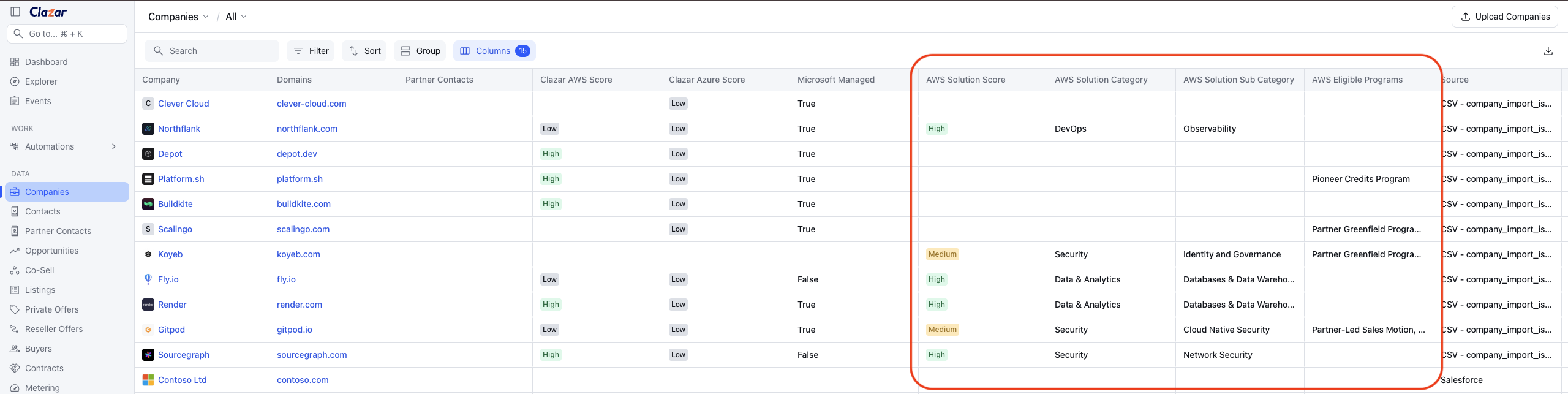
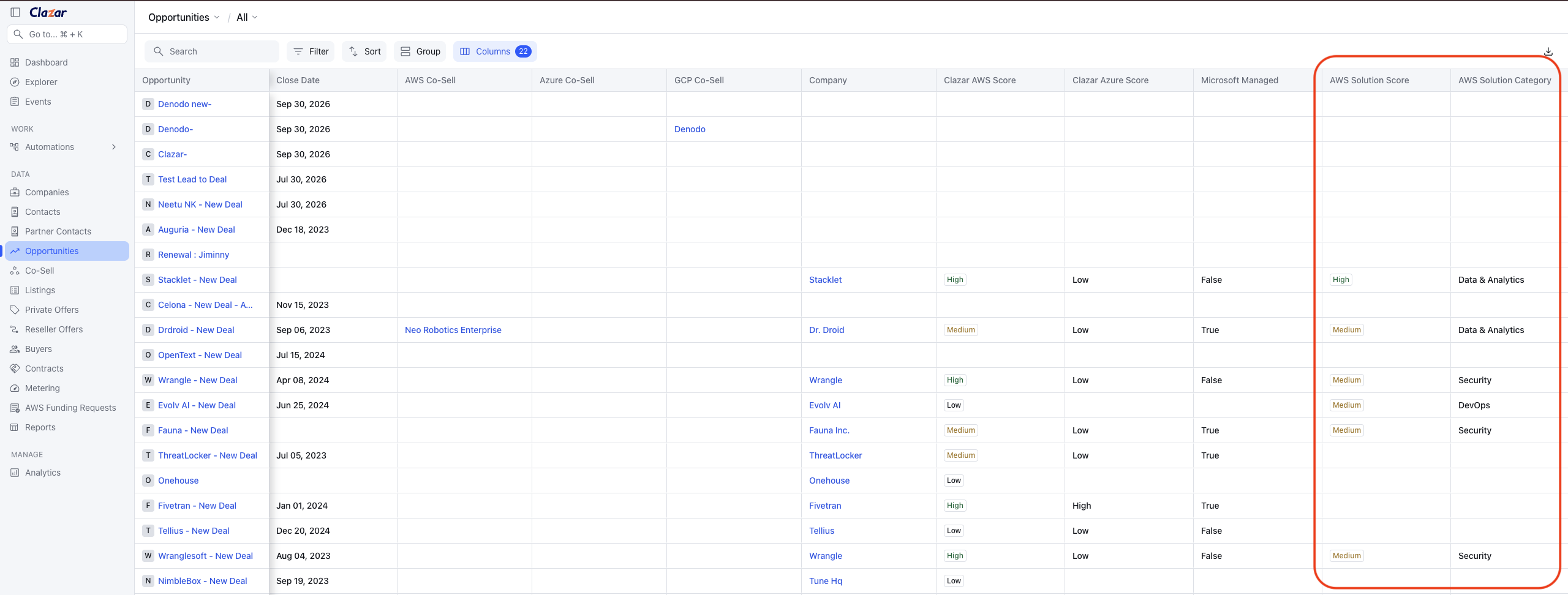
The Companies object in Clazar centralizes account-level visibility. AWS engagement score, Azure MACC eligibility, and Clazar's consolidated P2B score all sit in one place, with filter, sort, and download options.
For ISVs selling across multiple marketplaces, this cross-cloud view matters. A buyer with low AWS propensity might have high Azure propensity, and reps can see that in the Companies view without switching between cloud portals.
But it goes deeper than propensity. Companies also carry AWS's own read on what each account needs.
- Solution Score shows how likely the account is to buy a given category of solution
- Solution Category and Sub-Category name the specific category that AWS's internal data suggests is the best fit
- Eligible Programs list the AWS programs the account qualifies for
These come from AWS Partner Central's lead enrichment, matched against AWS's own CRM data.
CRM integration
Since Clazar integrates with your CRM, propensity scores also sync with Salesforce or HubSpot. Import company and account data from your CRM, and export enriched propensity scores back, so reps see them in their existing workflow without switching tools.
With the Pipeline Scoring feature, Clazar also shows you the likelihood of cloud marketplace purchases across your open opportunities. This pipeline-wide view complements the account-level P2B score.
Buyer 360
Buyer 360 from Clazar is a comprehensive buyer profiling view that tracks the buyer's journey from first engagement through contract, including contract management and metering audit. It closes the gap between "this account is likely to buy" and "here's where they are in the process."
Co-sell prioritization with rep mappings
On the co-sell side, Clazar connects P2B scores to actionable next steps. Hyperscaler rep mappings show which AWS or Azure seller is assigned to a given account, and co-sell readiness indicators flag whether the deal is ready to submit.
Instead of manually reviewing marketplace signals across accounts, your team sees the top accounts to engage, ranked by propensity.
Measuring what the scoring produced
Clazar's co-sell analytics track sourced vs. influenced revenue, partner velocity, pipeline contribution, and per-rep performance. You score your pipeline, prioritize based on propensity, submit to the cloud provider, and then measure whether high-propensity accounts actually closed at a higher rate and with more hyperscaler support.
That data feeds back into how you allocate co-sell resources next quarter.
How to predict your AWS Quality Score before you submit an opportunity
P2B scoring tells you which accounts to submit. But the quality of the submission itself matters too. AWS gives every co-sell opportunity an Opportunity Quality Score after it's submitted, and a higher score makes it more likely that an AWS seller gets assigned to the deal. AWS doesn't publish how it calculates that score, and ISVs only see it after the fact.
Clazar's predictor fills that gap. On a draft co-sell opportunity, Clazar estimates the score AWS is likely to give and lists specific changes that will raise it most. Each suggestion tells you which field to change and the points the change can add to your score.
The Predicted AWS Quality Score panel in Clazar gives you a predicted score out of 100 and a band: Low (0–25), Medium (26–50) or High (51–100). Open or create a draft opportunity, select Analyze, see the predicted score and suggestions, make the changes, analyze again. Suggestions you've addressed disappear and the next ones appear.
This means that instead of submitting and hoping for a decent Quality Score, your reps can iterate on the draft until the predictor shows a high score before it ever reaches AWS.
AWS Opportunity Insights: what happens after you submit
Once a co-sell opportunity is submitted through Clazar, AWS attaches AI-generated intelligence to it. Clazar writes that intelligence back to your Salesforce and HubSpot automatically, so your team sees it where they work.
This is what you see in Clazar’s custom object within Salesforce or HubSpot:
- Opportunity Quality Score. AWS's AI-generated score from 0 to 100, rating how strong the deal looks
- Opportunity Quality Trend. Whether the score is Improving, Declining, or showing No Change over time
- Quality Recommendation. AWS's written guidance on how to strengthen the opportunity
- Co-Sell Motion. How AWS is engaging on the deal: Partner-led, AWS Field-engaged, or Agent-engaged
That last field answers the question most ISVs ask after submitting: "What is AWS actually doing on my deal?" Instead of waiting for an email from your AWS rep or checking Partner Central, you can see the engagement model inside Salesforce or HubSpot.
This also closes the loop with P2B scoring. You scored a set of accounts as high-propensity, submitted them for co-sell, and now you can see whether AWS agrees. A high Quality Score and a trend marked Improving validates your scoring. A declining score on a deal you thought was strong is a signal to revisit the opportunity details or check the recommendation AWS attached.
What changes when you lead with data
Most Alliances teams run on relationships and gut feel. They know which AWS reps pick up the phone, which accounts “feel” like marketplace buyers, which deals are worth pushing. That works until someone leaves, the team doubles, or you’re trying to prioritize 200 accounts instead of 20. Intuition doesn’t scale.
Propensity scores in your CRM and Quality Score predictions on every draft opportunity turn that intuition into a system. A new AE can look at an account and know whether it’s worth a co-sell submission. And each quarter’s buyer intent data sharpens the next one; you learn which signals actually predicted cloud provider engagement and which were noise.
See how Clazar surfaces high-propensity accounts before you submit a deal. Request a demo with our experts today.
Frequently asked questions
What is the difference between an engagement score and a propensity-to-buy score?
An engagement score measures how actively an account interacts with a specific cloud marketplace. A propensity-to-buy score predicts the likelihood that the account will transact. The two are complementary; together they give a more complete picture.
Can I use propensity scores without a co-sell motion?
Yes. Propensity scores are useful for any marketplace sales motion, including direct private offers and renewals. If an account has a high propensity score, they're likely to transact through the marketplace whether co-sell is involved or not. The score tells you to ask the marketplace question earlier in the sales cycle.
How often do propensity scores update?
The scoring model refreshes as the underlying data changes. In Clazar, the latest scores are always available on the platform. CRM export is supported today; live-updating CRM sync (where scores refresh automatically in Salesforce or HubSpot as new data comes in) is on the roadmap.
Should I submit every high-propensity account for co-sell?
Not necessarily. A high propensity score means the account is likely to transact through the marketplace. Co-sell is one path to getting there. If you already have an active deal in motion with strong buyer engagement, a direct private offer might close faster. Use propensity to decide whether to go through the marketplace; use pipeline data to decide how.