
.png)
.png)
Introduction
The cloud marketplace promise
The cloud marketplace promise is clear: faster deals, wider reach, and stronger alignment with hyperscalers who now shape most software buying decisions. But turning that promise into repeatable, scalable revenue is where many teams hit turbulence.
In building the 2025 State of Cloud Marketplace & Co-Sell Report, we spoke with GTM leaders, partnership owners, RevOps teams, and executives at every stage of the journey. What we found was both encouraging and grounding. The opportunity is real, the momentum is building. But the teams seeing results are making deliberate choices around training, measurement, field engagement, and co-sell execution.
This study isn’t just a benchmark. It’s a map to help you understand where your team stands and which levers to pull to drive better marketplace outcomes in 2025 and beyond.
Key findings at a glance
- Are marketplaces driving new revenue?
Yes — 62% of companies generate net-new revenue from marketplaces, reaching customers they couldn’t have closed otherwise. - Who’s pulling ahead?
Only 22% of ISVs drive more than 20% of total revenue through marketplaces. This top tier outperforms peers with higher win rates, bigger deal sizes, and faster new logo acquisition. - Is co-sell working?
71% of companies are co-selling with hyperscalers, but 51% say the process is too complex to scale consistently. - What’s slowing growth?
42% of RevOps teams remain unconvinced about marketplaces, which delays automation, attribution, and reporting maturity. - How are teams running marketplace operations?
Fewer companies are building in-house tools. 41% now use purpose-built marketplace platforms for CRM integration, reporting, and workflow automation. - The big takeaway:
cloud marketplaces are a proven revenue channel, but only disciplined operators are seeing consistent impact.
New money, new motions
Cloud marketplaces as a growth engine
Are cloud marketplaces just shifting deals, or creating new ones? The data shows they’re driving net-new growth.
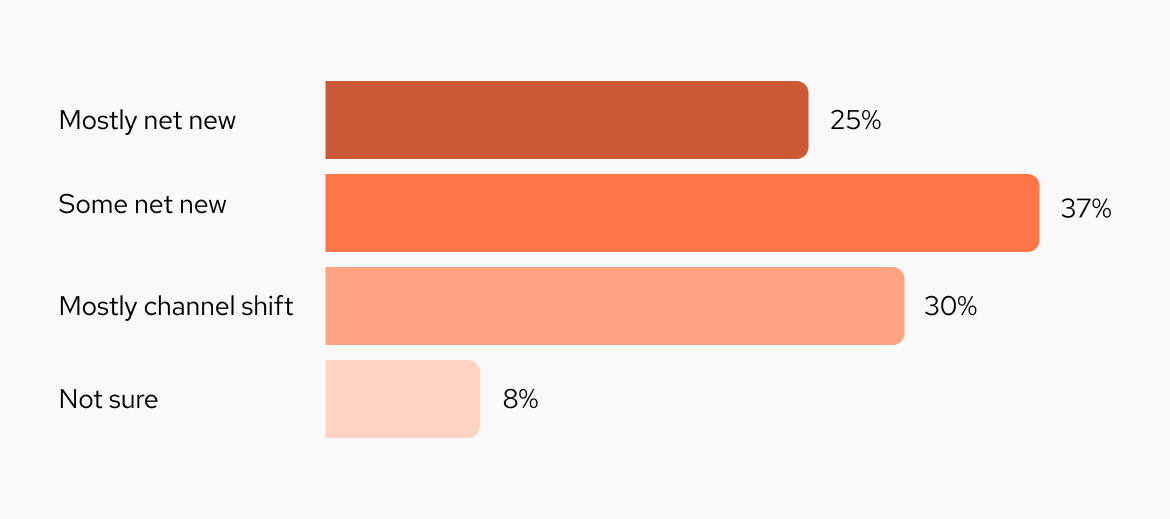
- 62% of companies report generating revenue from customers they wouldn’t have reached otherwise.
- Only 30% say their marketplace deals are mostly shifts from direct sales.
This marks a real change in how software is being bought. Buyers want speed and simplicity, and marketplaces cut through long onboarding, legal, and procurement cycles. Enterprises also use them to burn down existing cloud commitments, making it easier to optimize spend without new budget approvals. For CFOs and procurement leaders, marketplace spend is easier to justify, track, and consolidate.
Sellers are leaning in too. ISVs are routing deals through marketplaces to unlock co-sell incentives, sales acceleration funds, and faster deal velocity. And hyperscalers are reinforcing the trend — AWS, Microsoft, and Google field teams are more likely to support opportunities that transact through the marketplace, since those deals directly help them hit consumption targets.
The result is a broader shift toward marketplace-first procurement. It’s no longer just a customer preference; finance leaders, sellers, and hyperscalers are all aligned in making the marketplace the preferred path. For SaaS companies, the message is clear: treating the marketplace as a core channel unlocks faster sales cycles, stronger field support, and incremental growth in 2025.
Beyond the listing
Why execution matters more than presence
Simply being listed on a cloud marketplace isn’t enough to see meaningful results. The companies reporting higher win rates and larger deal sizes are the ones treating marketplaces as a core sales motion, not just an alternate procurement path.
The data makes this clear:
- 54% of respondents reported higher win rates on marketplace deals.
- 50% said marketplace deals deliver larger deal values compared to direct sales.
- 48% confirmed they were able to acquire more new customers through the marketplace
What drives this uplift isn’t the listing itself but the execution behind it. The ISVs seeing the biggest gains are those who actively co-sell with hyperscaler teams, engage in joint account planning, and invest in training their sales orgs to navigate marketplace mechanics with confidence. Sellers who lean into these motions are not only closing deals faster but also opening doors to bigger, more strategic enterprise opportunities.
The lesson is clear: marketplaces work best when they are woven into the daily rhythm of selling. By investing in co-sell alignment, sales enablement, and proactive collaboration with hyperscalers, SaaS companies can turn a simple marketplace listing into a repeatable revenue engine that consistently delivers bigger wins.
What is the “22% Club” in cloud marketplaces?
Most SaaS companies are still early in their marketplace journey — in fact, 41% report that only 0–5% of revenue comes from marketplace transactions. But a small cohort, we like to call them the “22% Club,” is already driving 20%+ of their total revenue through cloud marketplaces. And the results are striking.
Compared to their peers, the 22% Club reports:
- 75% win rates vs. 47% for the rest of the market
- 50% higher deal values vs. 42%
- 48% stronger new customer acquisition vs. 44%
48% stronger new customer acquisition vs. 44%
Success in cloud marketplace sales isn’t about doing more activities, but about doing the right things with precision:
- Automation first: 63% of the this club have automated submissions and workflows, more than double the rest of the market.
- Deeper field engagement: 94% actively engage hyperscaler field teams (vs. 77%), securing stronger pipeline support.
- Execution over alignment: Many companies have executive buy-in and AE participation, but the leaders translate alignment into disciplined execution, repeatable processes, and measurable outcomes.
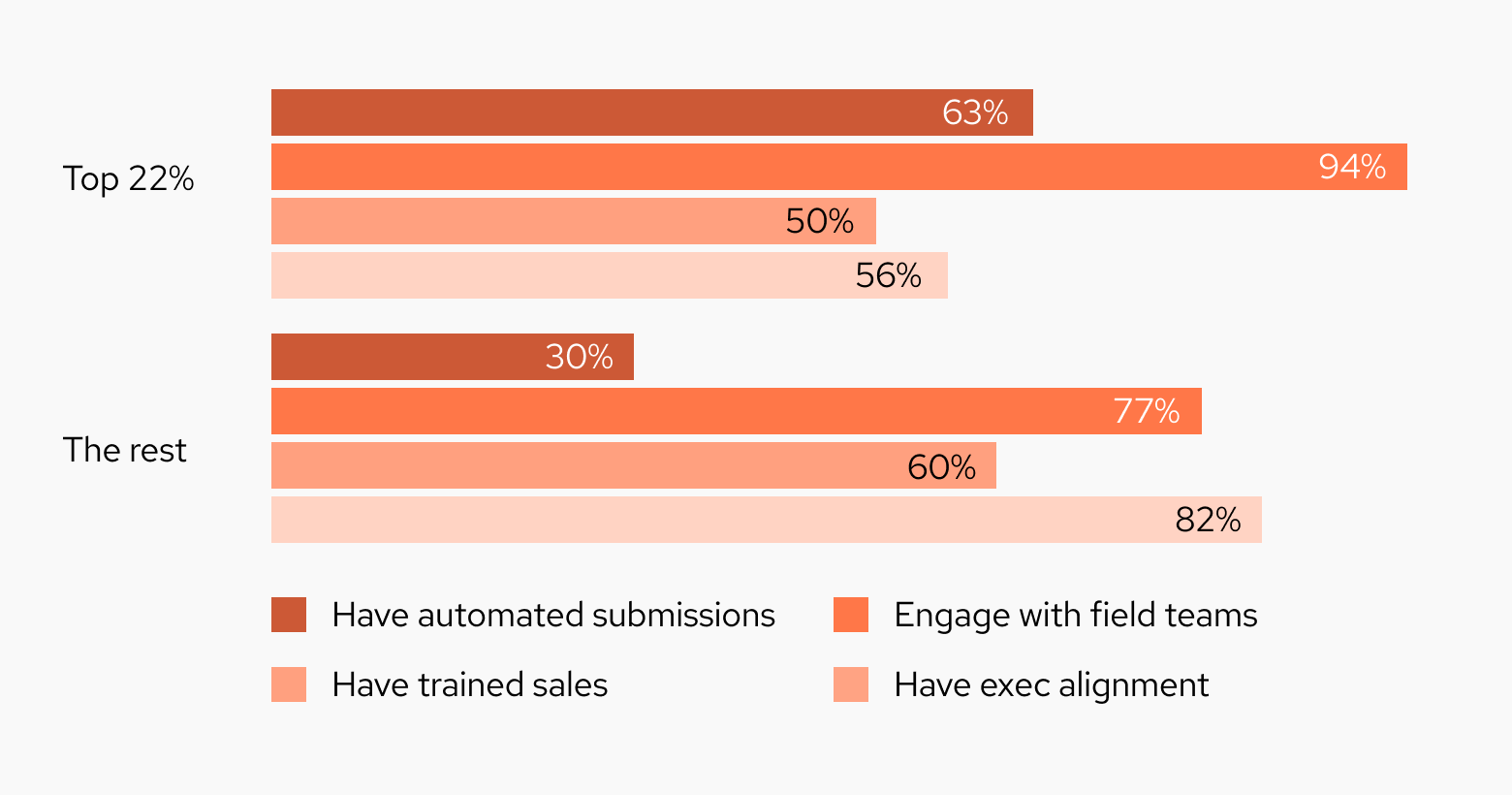
To join the 22% Club, SaaS companies need to go beyond surface-level marketplace participation and focus on disciplined execution. That means prioritizing RevOps automation to remove manual bottlenecks and ensure reporting and deal flow scale smoothly. It also requires embedding field seller engagement directly into sales motions, treating hyperscaler collaboration as a consistent part of the process rather than an ad hoc activity. Finally, leading companies are using marketplace deals strategically to unlock larger enterprise opportunities, not just treating them as a faster way to transact.
How aligned are sales, partnerships, and RevOps on cloud marketplaces?
One of the biggest barriers to scaling cloud marketplace revenue isn’t external — it’s internal. The data shows that while most partnership teams are bought in, sales and RevOps alignment lags behind, creating friction that slows growth.
The survey revealed clear differences across functions:
- 84% of partnership teams report full or partial alignment with marketplace strategy.
- 75% of sales teams show some buy-in, but only 22% are fully aligned.
- 58% of RevOps teams express some support, while 38% remain neutral, and just 29% are fully aligned
This uneven alignment means many GTM organizations are still treating marketplaces as an add-on rather than a core revenue engine. Without sales fully integrated into marketplace motions, deals risk being deprioritized. And without RevOps buy-in, automation, attribution, and reporting often stall, leaving marketplace revenue stuck in manual mode.
The companies making progress are the ones who educate sales on how marketplaces shorten deal cycles, train AEs to qualify marketplace-ready opportunities, and adjust compensation plans to reward cloud sales fairly. For RevOps, success comes from keeping workflows simple, automating repetitive steps like submissions and reporting, and proving ROI through clear revenue attribution.
The takeaway: alignment isn’t just cultural, it’s operational. Marketplace growth requires sales, partnerships, and RevOps to pull in the same direction. Otherwise, even strong intent can get stuck in execution.
.png)
Director, UserTesting
Why is co-sell still so complex for SaaS companies?
Most ISVs see the value of co-selling with hyperscalers, but many still struggle to make it scale. The majority of teams have started experimenting, yet the process often feels more complicated than the payoff.
The survey data highlights both the promise and the pain:
- 71% of companies are already co-selling with AWS, Microsoft, or Google.
- Only 32% have structured, proactive cadences with field teams (like joint pipeline reviews or account mapping).
- 51% cite co-sell complexity as a major blocker to scaling their marketplace motion
The challenge comes down to operational maturity. Effective co-sell isn’t just registering a deal in a portal. It requires dedicated owners, CRM integration, and repeatable workflows that make collaboration easy for sellers. Top performers are designating internal co-sell leads, syncing deal data directly into their CRM, and using tools to automate submissions and reporting. This reduces swivel-chair selling and frees up AEs to focus on building real field relationships.
The takeaway is clear: co-sell can be a powerful accelerator, but only when it’s simplified, automated, and embedded into the daily sales rhythm. Without that foundation, it remains a high-potential lever that too often gets underutilized.
.png)
Ex-Sisense
Are ISVs making the most of hyperscaler field teams?
Engaging with AWS, Microsoft, and Google field sellers is one of the fastest ways to accelerate marketplace growth. But most ISVs aren’t fully capitalizing on the opportunity. While many have established some level of contact, far fewer have built the structured, repeatable cadences that drive real results.
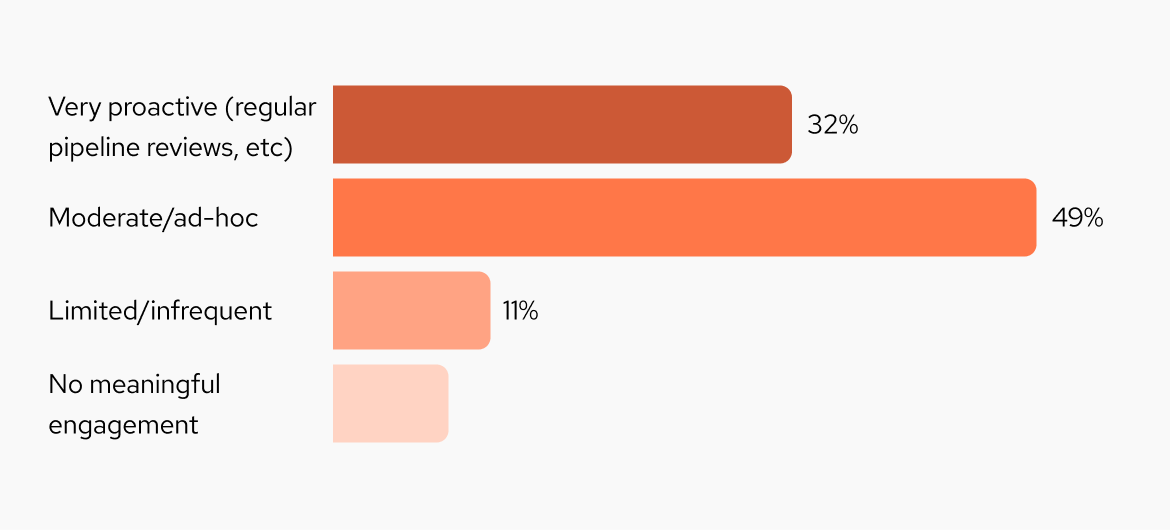
The survey revealed a telling gap:
- 81% of ISVs report some level of engagement with their hyperscaler contacts.
- But only 32% have established proactive cadences like joint pipeline reviews or co-marketing.
- 19% still struggle to build meaningful relationships with hyperscaler reps.
- Of those not engaging proactively, 57% cite lack of internal resources or enablement as the main reason.
This shows that while most companies have opened the door to partner conversations, too many stop short of building the trust and rhythm needed for ongoing field advocacy. The ISVs making progress are the ones that come prepared — with clear value propositions, regular syncs, and account-specific plays that make the hyperscaler seller’s job easier.
The lesson: engaging hyperscaler field teams isn’t about a single touchpoint. It’s about turning that relationship into a consistent, structured motion that amplifies pipeline and opens doors to customers you wouldn’t reach on your own.
.png)
Spur Reply
What’s holding back sales teams from cloud marketplace success?
Even when companies have marketplace listings and co-sell programs in place, many struggle to operationalize them. The gap often comes down to sales enablement — training, compensation, and integration into day-to-day sales motions. Without these foundations, even the best marketplace strategy can stall.
The survey data shows where companies stand:
- 60% of ISVs participate in hyperscaler programs like ISV Accelerate.
- 58% have started AE training on marketplace selling.
- 56% report compensation neutrality or better, ensuring cloud deals aren’t penalized.
- But only 37% have automated usage tracking and submissions, and just 33% track revenue attribution and payouts cleanly in their CRM
This means a large share of sales teams are still left without the confidence, incentives, or tools they need to prioritize marketplace deals. Companies making progress are embedding marketplace training into onboarding, aligning comp plans with cloud sales, and integrating marketplace workflows directly into their CRM so AEs don’t have to jump between systems.
The takeaway: marketplace growth isn’t just a partnership or RevOps priority — it requires equipping sellers to sell cloud-first. When training, compensation, and tools align, marketplace motions become part of the sales culture, not an afterthought.
.png)
Cloud Alliances, Datadog
How automated are cloud marketplace operations today?
As cloud marketplace revenue grows, companies are realizing that manual processes won’t scale. The leaders are investing in automation across reporting, usage tracking, and revenue attribution, turning what was once admin-heavy work into streamlined, repeatable workflows.

The survey shows that automation is still in its early stages, but momentum is building:
- 72% of companies have started automating marketplace reporting and analytics, though only 21% are highly automated.
- 62% are automating usage tracking and submissions, with just 15% at a high level of maturity.
- 60% have introduced revenue attribution automations, with 20% reporting advanced automation
This means many ISVs are still operating in a hybrid world where some processes automated, but much of the work still manual. The result, is slower reporting, more errors, and missed opportunities for co-sell benefits that depend on accurate usage data.
The companies getting ahead are those using purpose-built marketplace platforms that plug into CRMs and hyperscaler systems, eliminating swivel-chair selling and reducing dependency on internal engineering teams. By automating submissions, reporting, and attribution, they not only free up GTM teams to focus on selling but also gain cleaner data to guide strategy.
The takeaway: automation is no longer optional. As marketplaces move from experimental to core revenue channels, scalable operations will be the difference between growth and stagnation.
What’s slowing down marketplace growth?
Even as adoption surges, many ISVs find themselves struggling to scale because of operational hurdles. The biggest challenge isn’t whether to sell through marketplaces. It’s how to manage the complexity that comes with them.
The top obstacles identified by GTM leaders include:
- 59% cite lack of internal training and enablement.
- 51% say co-sell requirements are too complex to scale.
- 37% struggle to integrate marketplace data into their CRM or workflows.
Behind these numbers are real pain points. Sellers spending more time logging activities than actually selling, RevOps teams juggling multiple cloud portals, and leaders struggling to prove ROI without clean reporting. For smaller teams especially, meeting hyperscaler requirements — from deal registration criteria to proof-of-value steps — can feel overwhelming.
But within this complexity lies the opportunity. Companies that simplify workflows, invest in automation, and build clear playbooks for co-sell are turning a high-friction process into a repeatable growth engine.
The takeaway: complexity is the tax on early marketplace motions. But solving it unlocks scale. The ISVs that push through with training, automation, and integrated systems will be the ones to accelerate ahead.
Should ISVs build or buy their marketplace tech stack?
As marketplace motions mature, many ISVs face a critical decision: build internal tools to manage marketplace operations or adopt purpose-built platforms designed for the job. While building offers flexibility early on, the data shows that more companies are moving toward buying dedicated solutions that scale.
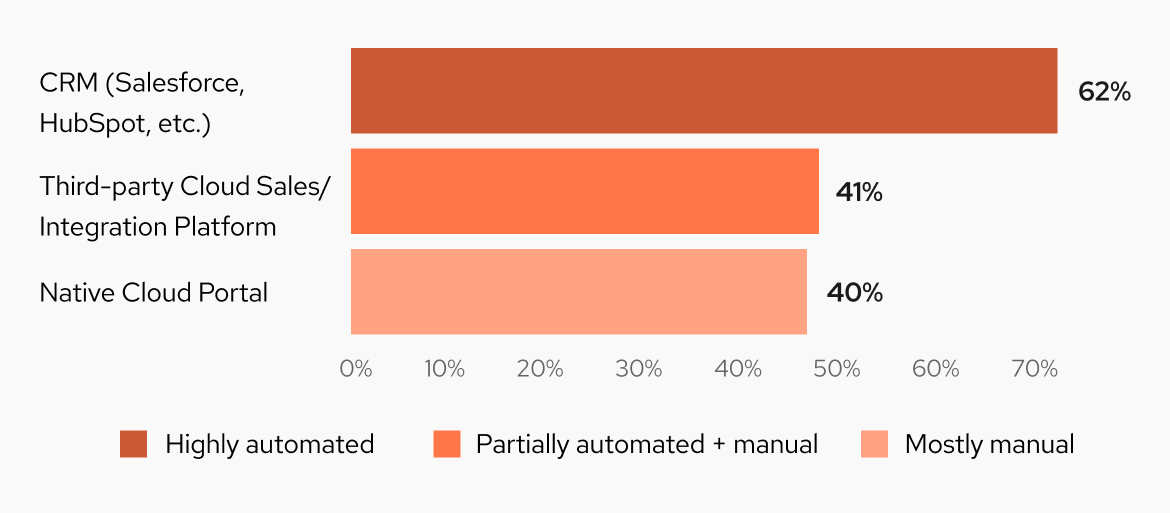
Here’s how companies are running their marketplace operations today:
- 62% manage workflows directly through their CRM (Salesforce, HubSpot, etc.).
- 41% use a third-party cloud sales or integration platform.
- 40% have built in-house solutions to handle submissions and reporting.
On the surface, in-house tools seem like a shortcut with customized workflows, faster iteration, and early control. But the reality is costly. Hyperscaler APIs and requirements are constantly evolving, making it difficult for engineering teams to keep homegrown tools current. Over time, that creates tech debt and distracts from core product priorities.
By contrast, purpose-built platforms integrate seamlessly with CRMs, cloud marketplaces, and co-sell systems. They automate submissions, streamline usage tracking, and maintain alignment with hyperscaler changes without heavy engineering lift. For most ISVs, this approach enables faster scaling, cleaner data, and stronger field collaboration.
The takeaway: in the build vs. buy conversation, make your choice based on both immediate and long-term marketplace priorities. Companies that invest in proven platforms free their GTM and product teams to focus on selling and innovation, not maintaining tools.
Why are buyers pushing SaaS companies onto cloud marketplaces?
We already saw that marketplace adoption isn’t just a vendor strategy anymore but a customer-driven mandate. Buyers increasingly prefer to transact through AWS, Microsoft, or Google marketplaces because the process is faster, simpler, and tied to budgets they already control. For ISVs, this shift means marketplace participation is less about choice and more about meeting customers where they are.
The data underscores this pull from the buyer side:
- 65% of ISVs say customer preference or contractual simplification was the main driver behind their marketplace adoption.
- 56% were motivated by co-selling or co-marketing opportunities with hyperscalers.
- 55% pointed to marketplace access as a way to reach a broader customer base and land new logos.
This highlights a dual value proposition: buyers gain speed and procurement efficiency, while sellers get access to broader markets and deeper relationships with cloud providers. Over time, this buyer-led momentum strengthens ISVs’ positioning with hyperscalers, unlocking additional support, funding, and pipeline acceleration.
The takeaway: buyers are rewriting the rules of SaaS procurement. ISVs that adapt quickly and lean into marketplace-led deals will not only satisfy customer demand but also gain a competitive edge in cloud partner ecosystems.
.png)
Which cloud marketplaces are ISVs betting on?
Nearly every SaaS company we surveyed is now listed on at least one hyperscaler marketplace. The survey highlights three key signals:
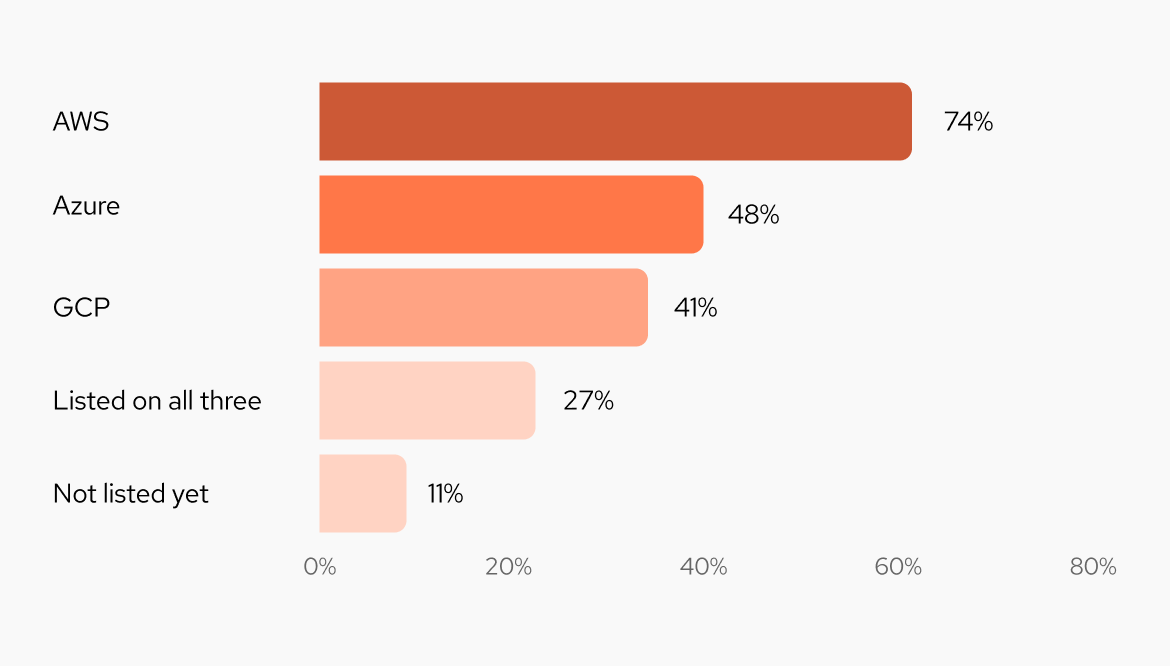
- 89% of companies are already transacting on one or more hyperscaler marketplaces.
- AWS remains the dominant platform, with the highest share of listings.
- 27% of ISVs are pursuing a multi-cloud strategy to maximize reach
What started as a procurement workaround has become a strategic route to market. But adoption doesn’t equal maturity. Many ISVs are still figuring out how to scale beyond listings with automation, co-sell, and structured field engagement.
The takeaway: being listed is now table stakes. Winning inside the cloud club means building the operational maturity that turns marketplace presence into predictable, scalable revenue.
.png)
How are channel partners shaping marketplace growth?
Resellers, GSIs, and regional integrators are starting to play a bigger role in cloud marketplace deals. Their involvement doesn’t just extend reach, it directly improves deal outcomes.
The survey highlights three important trends:
- 31% of ISVs report that channel partners influence more than 20% of marketplace deals.
- Companies with strong partner involvement see a 64% lift in win rates.
- 63% of respondents say channel partners are becoming critical to their marketplace GTM strategy.
ISVs that integrate partners into marketplace sales motions using tools like CPPOs or multi-party private offers don’t just move deals through the channel, they accelerate growth.
The takeaway: marketplace success is no longer a solo act. The future belongs to ISVs that embrace a three-way motion with hyperscalers and channel partners to amplify pipeline and scale faster.
How are ISVs scaling from scrappy motions to strategic cloud sales?
In the early days, marketplace participation often looked experimental — a quick listing, a manual co-sell process, or a reactive way to satisfy customer demand. But as revenue flowing through marketplaces grows, ISVs are shifting from scrappy motions to more strategic, scalable approaches.
The survey highlights where investments are headed next:
- 51% of companies plan to ramp up specialized internal training across sales, partnerships, and RevOps.
- 49% are doubling down on channel partner relationships to extend marketplace reach.
- 40% are investing in automation for usage tracking, compensation, and attribution
This shift signals a new phase: ISVs are no longer treating the marketplace as a side channel. They’re embedding it into their GTM model with intentional training, deeper automation, and tighter partner integration.
The takeaway: marketplace maturity is about building durable revenue motions. ISVs that refine their operations now — with training, automation, and partner alignment — will be the ones that scale fastest in the years ahead.
What’s next for cloud marketplace and co-sell in 2025 and beyond?
If 2023 and 2024 were the years of experimentation, 2025 marks the tipping point for cloud marketplaces as a true growth driver. The data shows that early adopters are already winning with higher revenue, faster cycles, and stronger hyperscaler alignment. The next wave of leaders will be those who operationalize these motions at scale.
The future of cloud sales will be defined by three shifts:
- Marketplace-first sales motions — buyers expect SaaS vendors to transact through marketplaces from the very first interaction.
- Deeply integrated co-sell — co-sell will move from ad hoc partner motions to a core part of the sales org, backed by RevOps and measured with shared KPIs.
- A new cloud sales stack — ISVs will invest in purpose-built tools that automate submissions, connect CRMs with hyperscaler systems, and give every seller the ability to engage partners confidently.
The takeaway: cloud marketplaces are no longer a side bet. They’re reshaping who wins in SaaS. Companies that approach them with strategic intent, operational discipline, and long-term investment will outpace their category and set the standard for the next generation of GTM.

%20(1).png)
.png)

.png)
.png)